


Narrative essay examples can help students understand how to tell a clear and engaging story through writing. A narrative essay is more than just sharing events; it shows a personal experience with a strong beginning, middle, and end. By reading examples, writers can see how to use characters, setting, and dialogue to bring a story to life.
These essays often focus on real moments, lessons learned, or meaningful memories, which makes them easy to relate to and interesting to read. Narrative essay examples also show how to organize ideas, stay focused on one main point, and keep the reader interested from start to finish. Whether you are new to narrative writing or trying to improve your skills, examples can guide you step by step. They make it easier to understand tone, structure, and style, helping you write a story that feels clear, personal, and engaging.
Key Features of a Narrative Essay
Clear Story Structure
A narrative essay has a beginning, middle, and end. The introduction sets the scene, the body tells the events in order, and the conclusion explains the lesson or outcome.
Personal Experience
Most narrative essays are based on real-life experiences. The writer shares a personal story that has meaning or importance.
Strong Theme or Message
Every narrative essay has a main idea or lesson. This message connects the events and gives the story purpose.
Vivid Descriptions
Good narrative essays use descriptive details to help readers imagine the setting, people, and actions.
Characters
The essay includes characters, often the writer and others involved in the story, who play a role in the events.
Chronological Order
Events are usually told in the order they happened, making the story easy to follow.
Engaging Conclusion
The ending reflects on the experience and explains what the writer learned.
Structure of a Narrative Essay
1. Introduction (The Hook and Setup)
The introduction draws readers into your story and establishes the foundation for what’s to come.
What to include:
- An engaging hook – Start with something that grabs attention: a vivid scene, intriguing dialogue, a thought-provoking question, or a surprising statement. Avoid generic openings like “Throughout history…” or “According to the dictionary…”
- Context and setting – Briefly establish when and where the story takes place, and introduce the main people involved.
- Foreshadowing or tension – Hint at the significance of what’s coming without giving everything away. This creates anticipation.
Example opening:
“The smell of antiseptic and the rhythmic beeping of monitors filled my grandmother’s hospital room. I had visited her dozens of times that summer, but this morning felt different—heavier somehow, as if the air itself knew something I didn’t.”
This hook uses sensory details, sets the scene, and creates tension without explicitly stating what will happen.
2. Rising Action (Building the Story)
This is the longest section of your narrative, where you develop the story and build toward the climax.
What to include:
- Sequence of events – Present events in a logical order (usually chronological) that builds momentum.
- Vivid details and description – Use sensory details, specific observations, and concrete language to bring scenes to life.
- Dialogue – Include relevant conversations that reveal character and advance the plot.
- Character development – Show yourself and others through actions, words, and reactions rather than just describing personalities.
- Building tension – Gradually increase stakes or emotional intensity as you approach the climax.
Structure tip: Use multiple paragraphs to break the rising action into distinct scenes or moments. Each paragraph should advance the narrative while maintaining focus.
Example:
“For three weeks, I had practiced my speech every night, pacing my bedroom while reciting the opening lines. My debate coach had assured me I was ready, but standing backstage now, listening to my opponent deliver her flawless introduction, doubt crept in like fog. When the moderator called my name, my legs felt like they’d forgotten how to walk…”
3. Climax (The Turning Point)
The climax is the most intense or important moment in your narrative—the point where everything changes or comes together.
What to include:
- The pivotal moment – This could be a realization, a decision, a confrontation, or an event that represents the peak of the story.
- Heightened detail – Slow down time and zoom in on this crucial moment with rich, specific details.
- Emotional intensity – Show the feelings and thoughts at this critical juncture.
Example:
“As I opened my mouth to respond to her final argument, something shifted. Instead of reciting my memorized rebuttal, I spoke from genuine conviction. The words came not from my notes but from something deeper—from actually believing what I was saying. For the first time all night, I forgot about winning and simply spoke the truth as I understood it.”
The climax doesn’t have to be dramatic or action-packed; it can be a quiet internal realization. What matters is that it represents the most significant moment in your narrative.
4. Falling Action (The Aftermath)
After the climax, the falling action shows the immediate consequences and begins wrapping up loose ends.
What to include:
- Immediate results – What happened right after the pivotal moment?
- Reactions and responses – How did you or others respond to what occurred?
- Transition toward resolution – Begin moving from the intensity of the climax toward reflection.
Example:
“I don’t remember walking off the stage or hearing the judges’ decision. My teammate hugged me, telling me I’d done well, but I barely registered her words. All I could think about was how different I felt from the person who had walked onto that stage twenty minutes earlier.”
This section is typically shorter than the rising action but provides necessary closure before the conclusion.
5. Conclusion (Resolution and Reflection)
The conclusion brings your narrative to a satisfying close and reveals its deeper meaning.
What to include:
- Resolution – Tie up the story’s loose ends. What was the final outcome?
- Reflection and insight – This is crucial: explain what the experience taught you or how it changed you. What larger truth does your story illustrate?
- Connection to the present – You might show how this experience still affects you or what you understand now that you didn’t then.
- Closing image or statement – End with something memorable that reinforces your theme.
Two approaches to reflection:
Explicit reflection: Directly state what you learned.
“That debate taught me that authenticity matters more than perfection. I didn’t win the competition, but I gained something more valuable—the confidence to trust my own voice.”
Implicit reflection: Show the change through your actions or perspective.
“Now, when I stand in front of an audience, I don’t reach for memorized lines. I reach for the truth, imperfect as it may be.”
High School Level Narrative Essay Examples
Example 1: The Day I Found My Voice
Introduction
My hands were shaking so badly that I could barely hold my notecards. I stood in the wings of the auditorium stage, watching my classmates file into their seats, their voices creating a low buzz that made my stomach churn. In exactly three minutes, I would have to walk onto that stage and deliver my speech for the school’s public speaking competition. Three minutes until I made a complete fool of myself in front of 200 people.
I had always been the quiet kid. The one teachers had to ask twice before I would answer. The one who ate lunch in the library to avoid the noise of the cafeteria. For fifteen years, I had perfected the art of being invisible, and it had kept me safe. But Mrs. Patterson, my English teacher, had other ideas. When she nominated me for this competition, I wanted to refuse. I should have refused. Now, standing backstage with my heart hammering against my ribs, I was certain this would be the worst mistake of my life.
Rising Action
“You’re on in two minutes,” the stage manager whispered, giving me an encouraging smile that I couldn’t return. I looked down at my notecards, but the words blurred together. My carefully memorized opening line had completely vanished from my brain.
I thought back to three weeks ago, when Mrs. Patterson had called me after class. “Jessica, I’ve read your essay on climate change,” she had said, holding up my paper. “You have important things to say. It’s time other people heard them.”
“I can’t do public speaking,” I had protested, my voice barely above a whisper. “I’ll mess up. I’ll forget everything.”
“Or,” she had replied with a knowing smile, “you might surprise yourself.”
I hadn’t believed her then, and I certainly didn’t believe her now. Through the gap in the curtains, I could see Marcus Chen finishing his speech about social media addiction. He was smooth, confident, making eye contact with the audience like he’d done this a hundred times. The audience laughed at his jokes. When I walked out there, they would probably just feel sorry for me.
“One minute,” the stage manager said.
My breathing was too fast. My hands were too cold. This was a mistake. I should leave. I could fake being sick. I could—
“Next up, we have Jessica Martinez speaking about ‘The Silent Crisis: Why We Must Act on Climate Change,'” the moderator announced.
My legs moved before my brain could stop them. Somehow, I was walking onto the stage. The lights were blinding. I couldn’t see individual faces anymore, just a dark mass of people. Maybe that was better.
I reached the podium and placed my notecards down, but my hands were shaking so badly that the cards scattered across the floor. A few people in the audience laughed—not mean laughter, but still. My face burned. This was exactly what I had feared. I bent down to pick up the cards, my vision blurring with tears I refused to let fall.
Climax
As I straightened up, cards clutched in my trembling hands, something inside me shifted. I looked out at that sea of faces, and suddenly, I wasn’t thinking about how scared I was. I was thinking about the wildfires I’d seen on the news last summer. About the article I’d read describing coral reefs dying. About my little brother, who might not have the same planet I grew up with.
I set the notecards aside.
“I’m terrified right now,” I said, my voice shaky but audible. “I dropped my cards. My hands are shaking. And I’m probably the least qualified person here to be giving a speech.” A few people in the audience nodded sympathetically. “But I’m not here because I’m good at public speaking. I’m here because I’m scared about something way more important than looking foolish on a stage. I’m scared about what’s happening to our planet.”
The words started flowing—not the polished, memorized version I had practiced, but something more real. I talked about the statistics I’d researched, yes, but I also talked about why I cared. About the hiking trips my family took every summer and how the glaciers had visibly shrunk. About my dream of becoming a marine biologist and my fear that there wouldn’t be healthy oceans left to study.
My voice grew steadier. I forgot about my shaking hands. I forgot about the audience judging me. For the first time in my life, I wasn’t trying to be invisible. I was choosing to be heard.
Falling Action
When I finished, there was a moment of silence that felt like an eternity. Then, applause. Not the polite, obligatory clapping I’d expected, but genuine applause. Some people were even nodding in agreement.
I walked offstage in a daze. Mrs. Patterson was waiting in the wings, beaming. “That,” she said, “was not the speech you practiced in my classroom.”
“I know,” I admitted. “I messed up. I dropped my cards and forgot half of what I’d memorized.”
“You didn’t mess up,” she said firmly. “You found your voice. There’s a difference.”
I didn’t win the competition. Marcus Chen took first place with his polished delivery and perfect timing. But when the judges announced the winners, I realized I didn’t care as much as I thought I would.
Conclusion
That day, I learned something more valuable than a trophy could represent: my voice matters, even when it shakes. Especially when it shakes. Being quiet had never made me feel safe; it had just made me feel small. But speaking up—really speaking up about something I cared about—made me feel powerful in a way I’d never experienced.
Now, two months later, I still get nervous before presentations. My hands still shake sometimes. But I don’t hide in the library at lunch anymore. I joined the environmental club and actually speak up at meetings. Last week, I even raised my hand in history class without waiting for the teacher to call on me.
I’m not the quiet kid anymore. I’m the kid who has things to say and is learning, one shaky word at a time, to say them. And it turns out that finding your voice isn’t about becoming someone new. It’s about finally letting people hear who you’ve been all along.
Example 2: A Lesson in Sportsmanship
Introduction
The scoreboard glowed in the dimming autumn light: 28-31. Four minutes left in the fourth quarter. We were down by three points in the regional championship game, and I had just fumbled the ball on our own thirty-yard line.
I lay on the cold turf, grass stains on my jersey, listening to the groans from our side of the bleachers and the roar of celebration from theirs. Oak Ridge High had recovered the fumble, and they were in perfect position to score again and put the game out of reach. My teammates helped me up, but I couldn’t meet their eyes. I was a team captain. I was supposed to lead us to victory. Instead, I might have just cost us the championship.
As I jogged back to the sideline, I caught sight of my dad in the stands. He’d taken off work early to be here. My mom was next to him, clutching my little sister’s hand. They’d all come to watch me win. Now they were going to watch me lose.
Rising Action
Coach Williams didn’t yell when I reached the sideline. That was almost worse. “Shake it off, Torres,” he said quietly. “Game’s not over.”
But I couldn’t shake it off. I stood on the sideline, helmet in my hands, watching Oak Ridge march down the field. Their running back, number 23, broke through our defensive line for a fifteen-yard gain. Then again for twelve more yards. They were unstoppable.
This was supposed to be our year. We’d been training since summer, running drills in the August heat until we thought we’d collapse. Every Friday night for the past ten weeks, we’d won. The local newspaper had run a story calling us “the team to beat.” College scouts had started coming to our games. I’d even gotten letters from two universities expressing interest in me.
“Torres! You’re back in!” Coach Williams shouted.
My stomach dropped. After that fumble, I thought for sure he’d bench me. But Oak Ridge had scored—making it 28-38—and now we had the ball with two minutes left. We needed two touchdowns. It was nearly impossible, but it was our only chance.
In the huddle, our quarterback, Jake, called the play. It was a passing play designed to get me the ball. I could see the doubt in some of my teammates’ eyes. Could they trust me not to mess up again?
“I’ve got this,” I said, trying to sound confident. “Just get me the ball.”
Jake nodded. “Break!”
We lined up. The crowd noise was deafening—half of them cheering for us, half for Oak Ridge. The ball snapped. I ran my route, broke free from my defender, and looked back. The ball spiraled through the air, perfect and fast. I caught it, tucked it, and ran.
Twenty yards. Thirty. I could hear footsteps behind me, getting closer. Forty yards. Someone’s hand grabbed my jersey, but I spun away. Fifty yards. The end zone was right there—
A tackle hit me from the side like a freight train. I went down at the twelve-yard line.
We scored on the next play. 35-38. One minute, fifteen seconds left. We were still down by three.
Coach called for an onside kick—a risky play where we’d try to recover our own kickoff instead of kicking it deep. It was our only hope of getting the ball back with enough time to score again. Our kicker set up for the kick. The whistle blew. The ball bounced awkwardly off the turf.
Players from both teams dove for it. Bodies piled up. The referee’s whistle blew, and he pointed toward Oak Ridge’s sideline. They had recovered it. The game was over.
Climax
I sank to my knees on the field, not caring that tears were streaming down my face. Around me, my teammates were doing the same—some sitting on the turf, some standing with their hands on their helmets, all of us stunned into silence. We had been so close.
The Oak Ridge players were celebrating at midfield, jumping and cheering. And they had every right to. They’d played a great game. But watching them celebrate made my chest ache with a hollowness I’d never felt before.
Then something unexpected happened. Number 23—their star running back who’d run all over us—walked over to our side of the field. He approached our team captain, Marcus, who was sitting on the bench with his head in his hands.
“Hey, man,” number 23 said, extending his hand. “That was one hell of a game. You guys are incredible.”
Marcus looked up, surprised. After a moment, he stood and shook the player’s hand. “Congrats. You guys earned it.”
More Oak Ridge players started coming over, shaking hands, offering words of encouragement. Their quarterback found Jake and spent a full minute talking to him about a play Jake had called in the third quarter. Their coach approached Coach Williams, and the two men embraced.
I was still on my knees when someone tapped my shoulder. I looked up to see number 23 standing there, hand outstretched. “That catch in the fourth quarter? That was insane, man. You’re a beast.”
For a moment, I just stared at him. Here was the guy who’d just beaten us, and he was complimenting my play? I thought about ignoring him, walking away, staying angry. That’s what I wanted to do. But as I looked into his face, I saw genuine respect. He wasn’t gloating. He was acknowledging that we’d pushed each other to be better.
I took his hand and stood up. “Thanks,” I managed to say. “You guys played great. Congrats.”
And I meant it. In that moment, something shifted inside me. The anger and disappointment were still there, but they weren’t the only things I felt anymore.
Falling Action
After the handshakes, after the team had dragged themselves to the locker room, Coach Williams gathered us together. I expected a pep talk about how proud he was despite the loss, the usual stuff coaches say. Instead, he said something I’ll never forget.
“You know what I saw out there at the end?” he said, looking around at all of us. “I saw a bunch of young men who know how to compete with class. Losing hurts. It should hurt. But how you handle that loss—that tells me more about your character than any win ever could.”
In the parking lot afterward, my family was waiting. My little sister ran up and hugged me, grass stains and all. “You were so fast!” she said. “You almost won!”
My dad put his hand on my shoulder. “Proud of you, son.”
“But we lost,” I said, my voice cracking.
“You competed with everything you had,” he replied. “And when it was over, you showed respect. That’s what matters.”
I wasn’t sure I believed him then. But I nodded anyway.
Conclusion
That was three years ago, and I’m now a freshman in college, playing football for a Division II school. It’s not the big-name program I’d dreamed about when I was in high school, but I love it. Last week, we lost a close game in overtime, and as I walked off the field, I made sure to shake hands with every player on the opposing team.
Looking back, I realize that fumble and that loss taught me more than any of our wins that season. I learned that your character isn’t defined by your highlights or your victories. It’s defined by how you handle your worst moments. Do you make excuses? Blame others? Give up? Or do you acknowledge the loss, learn from it, and keep working to improve?
I also learned that sports aren’t really about the scoreboard. They’re about testing yourself, pushing your limits, and respecting the people you compete against. Number 23 from Oak Ridge—his name was Derek, I later learned—became a Facebook friend. We still comment on each other’s posts, cheering each other on.
Sometimes I wonder what would have happened if we’d won that game. Would I have learned these lessons? Would I be the person I am today? I’ll never know. What I do know is that losing that championship, as painful as it was, gave me something more valuable than a trophy: the understanding that how you lose is just as important as how you win. And that’s a lesson I’ll carry with me long after my playing days are over.
College/University Level Narrative Essay Examples
Example 3: The Cultural Shift
Introduction
The taxi driver spoke no English, and I spoke approximately fifteen words of Mandarin—most of them related to ordering dumplings. As we hurtled through Shanghai’s neon-lit streets at what felt like twice the speed limit, weaving between buses and electric scooters with inches to spare, I clutched my backpack and questioned every decision that had led me to this moment. Three days ago, I had been in suburban Connecticut, where the most exotic thing in my daily routine was the occasional trip to the Thai restaurant downtown. Now I was alone in a city of twenty-four million people, armed with nothing but a semester’s worth of intermediate Chinese classes and an overconfidence that was rapidly evaporating.
The study abroad program had seemed like a perfect idea back in March, when I’d submitted my application from the safety of my dorm room. Six months in Shanghai, taking classes at Fudan University, immersing myself in a culture I’d only experienced through textbooks and choppy conversations with my professor. My parents had been hesitant—”Are you sure you’re ready for this?” my mother had asked repeatedly—but I’d brushed off their concerns with the invincibility of a twenty-year-old who’d never spent more than a week away from home. I was ready for adventure, I’d told them. I was ready to challenge myself.
As the taxi screeched to a halt outside my apartment building in the former French Concession, I realized that being ready for something and actually doing it were very different things.
Rising Action
The first week was disorienting in ways I hadn’t anticipated. The language barrier was obvious, yes—ordering coffee became a fifteen-minute ordeal involving frantic pointing and apologetic smiling. But it was the smaller things that threw me off balance. The way people stared openly at me on the metro, not with hostility but with curiosity, as if I were a species they’d only seen on television. The fact that my apartment had a squat toilet instead of the Western-style one I’d grown up with. The elderly women in the park who practiced tai chi every morning at six, moving in perfect synchronization while I stumbled to class, jet-lagged and disoriented.
I made rookie mistakes constantly. I showed up to dinner at someone’s house empty-handed, not knowing that bringing a gift was expected. I stuck my chopsticks vertically into my rice bowl, not realizing this resembled incense offerings for the dead. I tried to tip a taxi driver, offending him deeply. Each misstep felt like proof that I didn’t belong here, that I was just playing at cultural immersion while remaining fundamentally American, fundamentally foreign.
My roommate, Li Wei, a graduate student from Beijing, watched my struggles with what I initially interpreted as judgment but later recognized as patient amusement. She would gently correct my tonal mistakes in Mandarin, explain cultural nuances I’d missed, and occasionally drag me to local restaurants that served food I couldn’t identify but learned to love. Still, I felt like an outsider looking in, pressing my face against the glass of a culture I couldn’t quite access.
The breaking point came three weeks in, at a family dinner I’d been invited to by one of my classmates. I sat at a round table with her parents, grandparents, and various relatives, surrounded by dishes I couldn’t name and conversations I could barely follow. They were kind, asking me simple questions about America and encouraging me to eat more, always more. But I felt the weight of my difference acutely. When I fumbled with my chopsticks and dropped a piece of fish, splattering sauce on the tablecloth, the room fell silent. I felt my face burn red.
Then my classmate’s grandmother, a woman in her seventies who’d spoken barely a word all evening, reached across the table and patted my hand. “Méi guānxi,” she said softly. It doesn’t matter. She smiled at me, her face crinkling with genuine warmth, and suddenly everyone was talking again, laughing, refilling my bowl with rice. In that moment, something in my chest loosened slightly.
Climax
The shift happened gradually, then all at once, the way I imagine tectonic plates must move—slowly building pressure until something fundamental changes.
It was October, six weeks into my time in Shanghai, when I stopped thinking in English first. I was ordering breakfast from my usual street vendor, a woman named Auntie Chen who sold jianbing—crispy crepes filled with egg, scallions, and chili sauce—from a cart near my apartment. We’d developed a routine: I’d approach, she’d start making my usual order without me saying anything, and I’d hand her eight yuan while she’d ask about my day in Mandarin that was too fast for me to fully comprehend but that I’d respond to anyway with whatever vocabulary I could muster.
That morning, though, something was different. She asked me a question, and I answered—a full sentence about my upcoming exam, complete with the correct measure word and a joke about my professor’s strictness. She laughed, a real laugh, and responded with her own joke that I actually understood. We had a conversation. An actual, fluid conversation.
I walked away from her cart that morning with my jianbing cooling in my hands, and I realized I hadn’t translated anything in my head. I had just… spoken. Thought in Chinese. Responded naturally.
That same week, I stopped getting lost on the metro. I stopped converting prices to dollars in my head. I stopped flinching when strangers stood closer to me than Americans typically would. I began to recognize the rhythm of the language around me not as noise but as meaning—the tonal rise and fall that had once sounded like music I couldn’t read now made sense, like suddenly understanding a song’s lyrics you’d been mishearing for years.
And then came the moment that changed everything. Li Wei invited me to her family’s home in the suburbs for Mid-Autumn Festival. I almost declined—the thought of another family gathering where I’d feel inadequate was exhausting. But something made me say yes.
Her family lived in a modest apartment filled with three generations. They welcomed me with a warmth that felt different from the polite hospitality I’d experienced before. Maybe it was because I’d stopped expecting them to accommodate my foreignness. Maybe it was because I’d learned to navigate the unspoken rules—remove shoes at the door, accept food with both hands, address elders properly. Or maybe it was because I’d finally stopped performing “foreign student trying really hard” and had started simply being present.
We sat on the balcony under a full moon, eating mooncakes and watching fireworks light up distant buildings. Li Wei’s father asked me about my own family’s traditions, and I found myself explaining Thanksgiving, drawing parallels between our different ways of expressing gratitude and togetherness. He nodded thoughtfully, then said in careful English, “Every culture, same heart. Different words, same meaning.”
It was a simple observation, perhaps even trite, but something about it—combined with the mooncakes, the laughter, the way Li Wei’s grandmother kept refilling my tea cup—made me understand what I’d been missing. I’d been so focused on the differences, on all the ways I didn’t belong, that I’d failed to recognize the similarities. These were people gathering with family on a holiday, eating traditional food, celebrating connection. The specifics were different from my American experience, but the fundamental human impulse was identical.
Falling Action
The remaining months in Shanghai unfolded differently after that realization. I stopped trying so hard to prove I belonged and instead just lived. I joined a calligraphy class where I was terrible but enthusiastic, making friends with a retired teacher who corrected my brush strokes with patient precision. I started exploring neighborhoods without my phone’s GPS, getting lost and finding my way back, discovering hole-in-the-wall restaurants and elderly men playing xiangqi in parks.
I made mistakes still—plenty of them. I once accidentally told someone their baby was ugly when I meant to say cute, mixing up the tones for “chou” and “ke’ai.” I showed up an hour late to a meeting because I’d confused the date format. But these mistakes stopped feeling like evidence of my inadequacy and started feeling like just… life. Everyone makes mistakes, even in their own culture.
My Mandarin improved dramatically, not because I studied harder but because I stopped being afraid of sounding stupid. I had conversations on buses with strangers. I argued with street vendors over prices, the way locals did. I even started dreaming in Chinese occasionally, my subconscious finally accepting this new linguistic reality.
When Li Wei asked me one evening what had changed, I struggled to articulate it. “I think I stopped being a tourist,” I finally said. “Not that I’m Chinese now—I’m not. I’m still obviously American. But I’m also… here. Really here.”
She smiled. “You stopped watching and started living.”
Conclusion
I returned to Connecticut in February, stepping off the plane into the cold, familiar air of home. My parents picked me up from the airport, and on the drive back, everything looked simultaneously exactly the same and completely different. The roads seemed wider. The houses seemed farther apart. Everyone spoke English, and I understood every word without effort—a luxury I’d forgotten.
That night, unpacking in my childhood bedroom, I found myself disoriented again, but in a new way. Shanghai had changed me in ways I was still discovering. I caught myself bowing slightly when my mother handed me dinner. I instinctively reached for chopsticks before remembering we used forks. I felt uncomfortable with how much personal space Americans maintained.
The reverse culture shock was real, but so was something else: the understanding that I now carried two perspectives within me. I would always be American—that was my foundation, my first language, my cultural home. But I was also someone who had lived in Shanghai, who had navigated a different set of cultural rules, who had learned that “normal” is just a word for “what you’re used to.”
Now, two years later, I’m applying to graduate programs in international relations. My career path has shifted entirely because of those six months in Shanghai. But more than that, my worldview has shifted. I move through the world differently now—more curious, less assuming, more willing to sit with discomfort because I know that’s often where growth happens.
I still mess up tones in Mandarin, even though I continued studying it after returning. I still feel a pang of homesickness when I smell street food that reminds me of Auntie Chen’s jianbing. And I still have that mooncake tin Li Wei’s family gave me, now sitting on my desk, a reminder of a Mid-Autumn Festival when I finally understood that belonging doesn’t mean being the same. It means being willing to bridge the space between different and recognizing the humanity that exists on both sides.
The cultural shift wasn’t about becoming Chinese or abandoning my American identity. It was about expanding my sense of what’s possible, what’s normal, what’s home. Shanghai taught me that you can belong to more than one place, more than one way of being in the world. And that lesson—that fundamental expansion of perspective—is the real souvenir I brought back, worth far more than any trinket or photograph.
Example 4: The Impact of a Mentor
Introduction
I was twenty minutes into explaining my five-year plan when Professor Okafor interrupted me. “That’s a terrible plan,” she said, not unkindly, setting down her coffee cup with a soft clink against the saucer. “You’d be miserable.”
I sat in her cramped office on the third floor of the humanities building, surrounded by stacks of books that seemed to defy gravity and papers that had long since colonized every horizontal surface. Through the window behind her, I could see students crossing the quad, probably heading to parties or study groups, living the uncomplicated college experience I’d always felt slightly adjacent to. I had come here seeking approval, a signature on my application for the pre-law honors program, maybe some encouraging words about my future as an attorney. I had not come here to be told my carefully constructed plan was terrible.
“I… what?” I managed, my folder of application materials suddenly feeling heavy in my lap.
Professor Okafor—Dr. Okafor, technically, though she insisted her students call her by her first name, Amara, which none of us ever did—leaned back in her chair, studying me with the same intense focus she brought to analyzing Toni Morrison novels in her African American Literature seminar. It was that class, taken on a whim to fulfill a distribution requirement, that had led me to her office hours in the first place. Now I was regretting that decision.
“You just spent twenty minutes describing a career path you think you should want,” she continued, her Nigerian accent making the words feel both gentle and uncompromising. “Not once did you mention anything you actually want. So I’ll ask you directly: Why law school?”
Rising Action
The honest answer—because my parents expected it, because it seemed prestigious, because I was good at arguing and someone once told me that meant I should be a lawyer—felt too vulnerable to admit. So I gave her the rehearsed version, the one I’d perfected over months of telling relatives and family friends about my plans.
“I want to make a difference,” I said. “Help people. Use my analytical skills for social good.”
Professor Okafor raised one eyebrow, a gesture I’d seen her use in class to devastating effect when a student made an unsupported claim. “You can do all those things without law school. Why law specifically?”
I fumbled for an answer, but she was already moving on, pulling a book from one of the precarious stacks on her desk. “Have you read this?” She held up a collection of essays by James Baldwin.
“No, I—we covered some Baldwin in high school, but—”
“Take it,” she said, handing it to me. “Read the title essay, ‘The Fire Next Time.’ Then come back next week and tell me what you really want to do with your life.”
I left her office confused and slightly offended. I had come for a signature, not a existential crisis. But that night, instead of working on my law school personal statement, I opened the book.
Baldwin’s words hit me like a physical force. His rage and love, his refusal to accept easy answers, the way he used language not just to describe reality but to transform it—I read until 3 a.m., then started over from the beginning. I had always liked reading, had always done well in English classes, but this felt different. This felt like seeing what language could actually do in the hands of someone who wielded it with precision and purpose.
When I returned to Professor Okafor’s office the following week, I brought the book and a confession. “I don’t know why I want to go to law school,” I admitted. “I just know that everyone expects me to. My parents are immigrants—they came here with nothing, worked two jobs each to put me through school. Law feels like… success. Like justification for their sacrifice.”
She nodded, unsurprised. “And what do you want? Not what would make them proud, not what sounds impressive. What do you want?”
“I want to write,” I said, the words coming out before I could stop them. “I want to do what Baldwin does. Use words to make people see things differently.”
I expected her to tell me that was impractical, that writing wasn’t a real career, that I should stick with law school. Instead, she smiled. “So why aren’t you?”
Over the following months, Professor Okafor became an unexpected guide through a territory I had never seriously considered exploring. She recommended books—not just canonical literature but contemporary essays, journalism, cultural criticism. She invited me to attend a reading at a local bookstore, where I heard a writer I’d never encountered speak about using narrative to explore systemic injustice. She connected me with a graduate student who was starting an online magazine focused on social issues and needed contributors.
“Try writing something,” Professor Okafor suggested when I mentioned the magazine. “An essay about something you care about.”
“I don’t know what I’d write about,” I said.
“Yes, you do,” she replied. “You’re just afraid to say it out loud.”
She was right. I wrote an essay about the pressure children of immigrants face to pursue practical, prestigious careers, about the weight of gratitude and guilt, about dreams deferred in service of security. It was raw, personal, probably too honest. I almost didn’t submit it.
The magazine published it three weeks later. And then something unexpected happened: people read it. Strangers emailed me saying they’d felt the same pressure, the same conflict. My parents’ friends mentioned seeing it. One of my mother’s coworkers printed it out and gave it to her daughter, who was struggling with similar questions about her future.
“See?” Professor Okafor said when I told her, unable to hide my excitement. “Words have power.”
Climax
Spring semester of my senior year, I was supposed to be preparing for the LSAT. Instead, I was spending every spare moment writing—essays, criticism, experimental pieces that didn’t fit any particular genre. I had applied to law schools, hedging my bets, but my heart wasn’t in it. I was also, secretly, working on applications for MFA programs in creative nonfiction.
The crisis came in late March, when I received acceptance letters from two law schools, including one that had been my supposed dream school. My parents were ecstatic. They threw a small party, invited relatives, bought me a leather portfolio embossed with the law school’s name. I should have been happy. I was supposed to be happy.
Instead, I felt trapped.
I made an appointment with Professor Okafor, not sure what I was asking for—permission, maybe, or absolution. When I arrived at her office, she was grading papers, her red pen moving across the page with surgical precision.
“I got into Columbia Law,” I said without preamble.
“Congratulations,” she replied, not looking up. “Are you going?”
“I don’t know. I mean, yes? That’s the plan. That’s always been the plan.”
She set down her pen and looked at me directly. “Whose plan?”
“I just… everyone’s so proud. My parents sacrificed so much. How do I tell them I want to do something different? Something that might not even work out? Writing isn’t practical. It’s not a career.”
Professor Okafor was quiet for a long moment. Then she said, “Can I tell you something about my own experience?”
I nodded, surprised. She rarely spoke about her personal life.
“When I finished my PhD, my parents wanted me to return to Nigeria, work in government or education policy, use my degree for ‘practical’ purposes. They didn’t understand why I wanted to teach literature at an American university, why I cared so much about books and ideas. They thought it was selfish, impractical.”
“What did you do?”
“I took the teaching job. I disappointed them.” She paused. “For about two years. Then my mother came to visit. She sat in on one of my classes, saw me teaching Chinua Achebe, watched my students engage with ideas about postcolonial identity and narrative. Afterward, she said, ‘I understand now. This matters.'”
Professor Okafor leaned forward, her expression serious. “Your parents want you to be successful, yes. But more than that, they want you to be fulfilled. They might not understand immediately what you’re choosing or why. But if you’re doing work that matters to you, work that uses your gifts fully, they’ll see that eventually. And if they don’t—” she paused, “—you still have to live your own life. Their sacrifice was to give you choices. Honor that by making a genuine choice, not just the safe one.”
Something in my chest cracked open. “I got into an MFA program,” I admitted, the words tumbling out. “At Iowa. I haven’t told anyone because it seemed crazy to even consider it when I have law school acceptances. But I keep thinking about it. I keep imagining what it would be like to spend two years just writing, learning craft, being around other people who care about language the way I do.”
“So why are you here?” she asked gently. “What do you need from me?”
“I need someone to tell me I’m not making a huge mistake.”
Professor Okafor smiled, but she shook her head. “I can’t tell you that. I can’t promise you that choosing writing will lead to success or security or that your parents will understand right away. What I can tell you is this: I’ve been teaching for fifteen years. I’ve had hundreds of students. Most of them are perfectly fine—they got good jobs, they’re living comfortable lives. I’m happy for them.”
She paused, choosing her words carefully. “But every few years, I meet a student who has something to say and the ability to say it well. Those students are rare. You’re one of them. And it would be a waste—not just for you, but for everyone who needs to read what you’ll write—if you spent your life doing something else just because it’s expected.”
Falling Action
The conversation with my parents was as difficult as I’d feared. My mother cried. My father was silent for a long time, then asked quietly if I understood what they’d given up for me to have opportunities they never had. I tried to explain that I did understand, that I was grateful, that this wasn’t a rejection of them but an attempt to honor what they’d given me by using it fully.
“Writing is not a career,” my father said, echoing my own fears. “How will you support yourself?”
“I don’t know,” I admitted. “But I know that if I go to law school right now, I’ll spend three years studying something I’m not passionate about, then take a job I don’t want, and eventually I’ll be successful by all the conventional measures and completely unfulfilled.”
It was Professor Okafor’s words that finally helped them understand, or at least accept. “A teacher of yours,” my mother said slowly, “she thinks you should do this?”
“She thinks I have something to contribute,” I said. “And she’s spent her whole career recognizing talent and potential in students. She wouldn’t say that if she didn’t mean it.”
My parents didn’t give their blessing exactly, but they stopped actively opposing the decision. It was enough.
I deferred the law school acceptance for a year—a compromise that gave me an escape route if writing didn’t work out—and accepted the MFA offer. When I told Professor Okafor, she didn’t seem surprised.
“I’m proud of you,” she said simply. “It takes courage to choose the uncertain path.”
“I’m terrified,” I admitted.
“Good,” she replied. “That means it matters.”
Conclusion
That was four years ago. I completed the MFA, graduated without any clear job prospects, and spent a year freelancing, writing essays and articles for various publications while waitressing on the side to pay rent. It was hard—harder than law school would have been in many ways. There were months when I wondered if I’d made a catastrophic mistake.
But then I got a staff position at a magazine focused on social justice issues. I’ve published two collections of essays. I’m working on a book about second-generation immigrant experiences and the complexity of gratitude and ambition. It’s not a conventional path to success, and I’m certainly not wealthy. But I wake up most mornings eager to write, to engage with ideas, to contribute to important conversations through the medium I love most.
My parents came to my first book launch last year. My mother brought relatives and family friends, the same people who’d been at that celebration when I got into law school. She introduced me to each of them proudly: “This is my daughter. She’s a writer.” The way she said it—with genuine pride, not resignation—made me understand that Professor Okafor had been right. They needed time to see what this path looked like, but eventually, they recognized its value.
I still meet with Professor Okafor occasionally, though she insists I call her Amara now that I’m no longer her student. We have coffee, discuss books, debate ideas. She’s become not just a mentor but a friend, someone who fundamentally altered the trajectory of my life by asking one simple question: What do you actually want?
The impact of a mentor isn’t always about teaching you new information or opening doors through connections. Sometimes it’s about giving you permission to want what you want, to trust your own instincts, to choose the uncertain path because it’s authentically yours. Professor Okafor didn’t make my decisions for me—she just helped me see that I was allowed to make them at all.
That conversation in her cluttered office, surrounded by books and possibilities, gave me something more valuable than any career advice: the courage to listen to my own voice. And in choosing to honor that voice, I found not just a career but a purpose, not just success but fulfillment. That’s the real gift a mentor can give—not a map to follow, but the confidence to chart your own course.
FAQs
Can a narrative essay be written in first person?
Yes, most narrative essays are written in the first person using words like “I” and “my” because they are based on personal experiences.
Are narrative essays always true stories?
Most narrative essays are based on real events, but some may include creative elements as long as the story remains believable.
How is a narrative essay different from a descriptive essay?
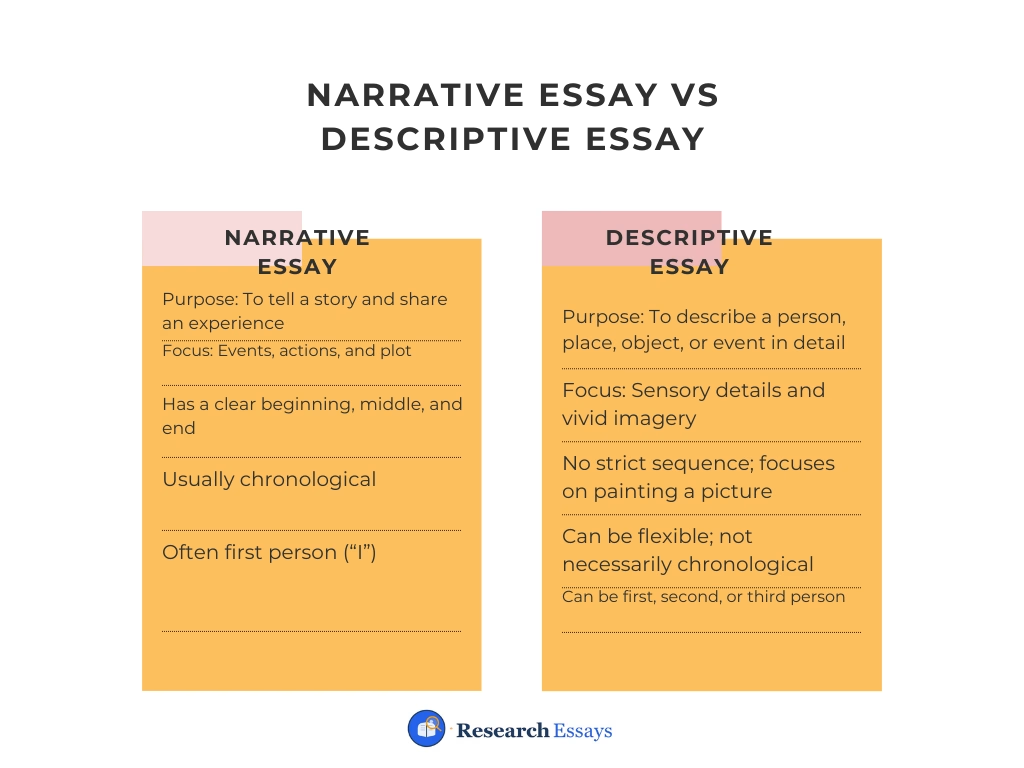
A narrative essay tells a story with events and actions, while a descriptive essay focuses on describing a person, place, or object.