


Quota sampling represents a non-probability sampling technique that researchers use when they need to ensure specific demographic groups are adequately represented in their studies. Unlike random sampling methods, quota sampling involves deliberately selecting participants to fill predetermined categories based on characteristics such as age, gender, income level, or geographic location. This approach proves particularly valuable when researchers face time constraints, budget limitations, or difficulty accessing certain populations through traditional random methods.
The technique mirrors the structure of stratified sampling but operates without the random selection component. Researchers establish quotas that reflect the broader population’s composition, then systematically recruit participants until each category reaches its target number. Market research companies frequently employ this method when conducting consumer surveys, while political pollsters use it to ensure their samples represent key voter demographics. Understanding how quota sampling works in real-world scenarios helps researchers determine when this method serves as an appropriate alternative to probability-based approaches.
What is Quota Sampling?
Explanation of the Method
Quota sampling operates on the principle of creating a miniature version of the target population by establishing specific quotas for different demographic segments. Researchers begin by identifying key characteristics that define their population of interest, such as age groups, gender distribution, income brackets, educational levels, or geographic regions. These characteristics become the foundation for creating distinct categories or “cells” within the sample framework.
Once researchers determine the relevant characteristics, they calculate the proportion each group represents in the broader population. For instance, if census data shows that 52% of a city’s population is female and 48% is male, the quota sample would maintain this same ratio. Similarly, if 30% of the population falls within the 25-34 age range, the sample would include 30% of participants from this age group. This proportional representation ensures that the sample reflects the demographic composition of the larger population being studied.
The quota system creates a structured approach to participant recruitment, where interviewers or researchers actively seek individuals who fit specific demographic profiles until each category reaches its predetermined target. This method provides researchers with control over sample composition while maintaining representativeness across key variables that might influence study outcomes.
Difference from Random Sampling
The fundamental distinction between quota sampling and random sampling lies in the selection process and underlying probability theory. Random sampling methods, such as simple random sampling or systematic sampling, rely on chance to select participants, ensuring every individual in the population has an equal opportunity for inclusion. This random selection process eliminates researcher bias and allows for statistical inference about the broader population with known confidence levels.
Quota sampling, conversely, involves purposeful and intentional selection of participants based on predetermined criteria. Researchers or field workers actively choose individuals who meet specific demographic requirements, making the selection process non-random. While this approach sacrifices the statistical rigor of probability sampling, it offers significant practical advantages in terms of speed, cost-effectiveness, and logistical feasibility.
The non-random nature of quota sampling means that traditional statistical tests for margin of error and confidence intervals cannot be directly applied. However, when properly executed with representative quotas, the method can produce results that closely approximate those obtained through random sampling, particularly for descriptive research purposes. The trade-off between statistical precision and practical efficiency makes quota sampling an attractive option for many research scenarios.
Common Uses
Market research represents one of the most widespread applications of quota sampling, where companies need quick insights into consumer preferences, brand awareness, or purchasing behavior. Consumer goods companies often use quota sampling to test new products across different demographic segments, ensuring feedback represents their target market’s diversity. The method’s speed and cost-effectiveness make it ideal for competitive market environments where timely data collection provides strategic advantages.
Opinion polling and political research extensively employ quota sampling to gauge public sentiment on various issues or candidate preferences. Polling organizations use demographic quotas based on voter registration data or census information to create samples that reflect the electorate’s composition. This approach allows pollsters to conduct surveys efficiently while maintaining demographic representativeness crucial for accurate political forecasting.
Social science studies frequently utilize quota sampling when studying specific populations or when random sampling proves impractical. Researchers investigating sensitive topics, hard-to-reach populations, or time-sensitive phenomena often find quota sampling more feasible than probability-based methods. Academic researchers studying urban communities, workplace dynamics, or health behaviors commonly employ this technique to ensure their samples include adequate representation from relevant demographic groups while managing research constraints and timelines.
Example Scenario: Market Research for a New Soft Drink
To illustrate quota sampling in action, consider a beverage company preparing to launch a new energy drink targeted at young adults. The company needs consumer feedback before finalizing the product’s flavor, packaging, and marketing strategy. The marketing team decides to conduct taste tests and focus groups using quota sampling to ensure their research captures insights from their primary target demographic.
Setting Up the Research Parameters
The research team begins by defining their target population: adults aged 18-35 living in major metropolitan areas who consume energy drinks at least once per week. Based on market research data and census information, they identify several key demographic variables that could influence energy drink preferences and purchasing decisions.
The team establishes the following demographic categories for their quota sample:
- Age groups: 18-24 years (40%), 25-29 years (35%), 30-35 years (25%)
- Gender: Male (55%), Female (45%)
- Income level: Under $40,000 (30%), $40,000-$70,000 (45%), Over $70,000 (25%)
- Geographic location: Urban core (50%), Suburban areas (50%)
These percentages reflect the demographic composition of their target market based on industry data and consumer research. The team decides on a total sample size of 400 participants, which will provide sufficient data while remaining within budget constraints.
Calculating Specific Quotas
With the overall framework established, researchers calculate the exact number of participants needed for each demographic cell. For the age distribution, they need 160 participants aged 18-24, 140 participants aged 25-29, and 100 participants aged 30-35. The gender split requires 220 male and 180 female participants across all age groups.
The income quotas translate to 120 participants earning under $40,000, 180 participants in the middle income bracket, and 100 participants earning over $70,000. Geographic distribution calls for 200 participants from urban core areas and 200 from suburban locations. These quotas often overlap, creating a matrix where participants must meet multiple criteria simultaneously.
For example, the research team needs approximately 35 urban-dwelling males aged 18-24 with incomes under $40,000, calculated by applying the relevant percentages to the total sample size. This level of specificity ensures the sample maintains proportional representation across all relevant demographic dimensions.
Recruitment and Data Collection Process
The beverage company partners with a market research firm that specializes in consumer product testing. Field researchers position themselves at shopping malls, college campuses, fitness centers, and other locations where the target demographic frequently visits. This strategic location selection increases the likelihood of encountering potential participants who meet the study criteria.
Recruiters approach individuals who appear to fit the demographic profile and conduct brief screening interviews to confirm eligibility. Questions cover age, income range, energy drink consumption habits, and residential location. Once a person qualifies, recruiters check their quota tracking sheets to determine if that specific demographic combination still needs participants.
As quotas fill up, recruiters become more selective, focusing only on hard-to-find demographic combinations. For instance, as the study progresses, they might specifically seek older, higher-income females from suburban areas if those quotas remain unfilled while others have reached capacity.
The actual research consists of taste testing sessions where participants sample different flavor variations, evaluate packaging designs, and discuss their preferences in structured interviews. Each session accommodates mixed demographic groups to encourage diverse perspectives while ensuring overall sample composition meets the predetermined quotas.
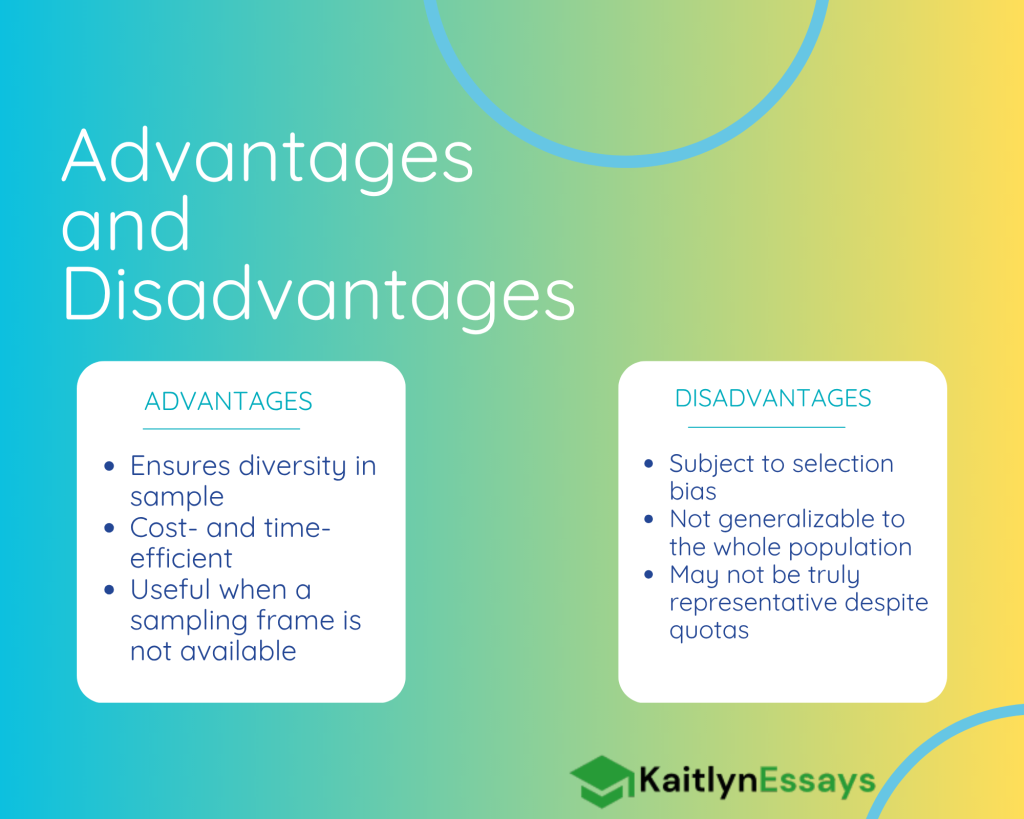
Advantages Demonstrated in This Scenario
This energy drink example highlights several key advantages of quota sampling in commercial research contexts. The method enabled the beverage company to collect representative data within a tight three-week timeframe, much faster than would be possible with random sampling methods that might require extensive contact attempts and callbacks.
Cost efficiency proved significant, as recruiters could focus their efforts in high-traffic areas where target demographics naturally congregate, rather than conducting expensive random digit dialing or mail surveys with uncertain response rates. The controlled recruitment process also minimized wasted interviews with individuals outside the target market.
The quota system ensured adequate representation of smaller demographic segments that might be underrepresented in a purely convenience sample. Without quotas, recruiters might have disproportionately selected easily accessible participants, such as college students, while missing working professionals or higher-income consumers who represent important market segments.
Limitations and Considerations
Despite its practical advantages, the quota sampling approach in this scenario also presents certain limitations that the research team must acknowledge. The non-random selection process introduces potential bias, as recruiters may unconsciously favor certain types of individuals within each demographic category based on appearance, approachability, or other subjective factors.
The geographic concentration of recruitment sites, while practical, may not capture the full diversity of consumer preferences across different neighborhoods or communities within the metropolitan areas. Individuals who frequent shopping malls and fitness centers might have different consumption patterns than those who shop online or exercise at home.
Additionally, the quota system cannot account for demographic intersections that might significantly influence energy drink preferences but weren’t included in the sampling framework. Factors such as lifestyle preferences, health consciousness, or cultural background could play important roles in product evaluation but remain uncontrolled in this sampling approach.
The research team addresses these limitations by conducting additional qualitative research methods and comparing their quota sample results with broader market data to validate findings. They also acknowledge the exploratory nature of their research and plan follow-up studies using different methodologies to confirm key insights before making final product decisions.
FAQs
What is the difference between quota sampling and stratified sampling?
Quota sampling is non-random; participants are selected based on set quotas for subgroups.
Stratified sampling is random; participants are randomly chosen from each subgroup.
What is the difference between quota sampling and convenience sampling?
Quota sampling selects participants to meet specific subgroup targets.
Convenience sampling selects whoever is easiest to reach, with no subgroup control.
What is the difference between purposive and quota sampling?
Purposive sampling selects participants based on the researcher’s judgment about who is most useful.
Quota sampling selects participants to fill specific demographic quotas, regardless of usefulness.