

Writing a concept paper is often the first step in turning an idea into reality. This short document outlines your project, research proposal, or business plan in clear, straightforward terms. Think of it as a preview that convinces others your idea deserves support.
A good concept paper answers key questions: What problem are you solving? Why does it matter? How will you approach it? What resources do you need? The document should be brief but compelling enough to capture interest.
Whether you’re seeking funding from investors, approval from supervisors, or academic support, your concept paper serves as your initial pitch. By organizing your thoughts clearly and highlighting the value of your idea, you create a foundation for more detailed work to follow.
What is a Concept Paper?
A Concept Paper is a brief document that outlines the essential elements of a proposed project, research study, program, or initiative. It serves as a preliminary step before developing a full proposal or plan and is often used to communicate the core ideas of a project to stakeholders, sponsors, or decision-makers for feedback or approval. The purpose of a concept paper is to provide a clear and concise overview of the project’s objectives, rationale, methodology, and potential impact, without going into the extensive detail required in a formal proposal.
When is it Used?
A Concept Paper is used at various stages of project development, research, or planning, depending on the context and the needs of the stakeholders involved. Below are some common scenarios when a concept paper is typically used:
1. Academic Research
- Before Submitting a Full Research Proposal : In academia, researchers often write concept papers to outline their proposed study before submitting a detailed research proposal. This helps them clarify their research questions, objectives, and methodology.
- Seeking Initial Feedback : A concept paper allows researchers to get feedback from advisors, professors, or peers early in the process, ensuring that the research idea is viable and well-structured.
- Grant Applications : Researchers may submit a concept paper to funding agencies or institutions to gauge interest in their research topic before investing time in writing a full grant proposal.
2. Grant Writing and Funding Requests
- Initial Contact with Funders : Nonprofits, NGOs, or other organizations often use concept papers as a way to introduce a project idea to potential funders or donors. It serves as a “pitch” to determine whether the funder is interested in the project before the organization invests time in preparing a full grant application.
- Soliciting Feedback : Concept papers allow funders to provide feedback on the project’s feasibility, alignment with their priorities, and potential impact before committing resources.
- Streamlining the Grant Process : Some funders request concept papers as part of a two-stage application process. If the concept paper is approved, the applicant may be invited to submit a full proposal.
3. Program Development
- Introducing New Initiatives : Organizations use concept papers to propose new programs, projects, or initiatives to internal leadership, board members, or external partners. It helps decision-makers understand the purpose, scope, and potential impact of the proposed program.
- Collaboration and Partnerships : When seeking partnerships or collaborations, a concept paper can serve as a tool to communicate the vision and objectives of a project to potential collaborators, ensuring alignment of goals and expectations.
- Internal Planning : Within an organization, concept papers can be used to explore new ideas or directions before committing significant resources to a project.
4. Policy Proposals
- Introducing Policy Ideas : Government agencies, think tanks, or advocacy groups may draft concept papers to introduce new policy ideas or reforms. These papers help policymakers understand the rationale behind the proposed policy and its potential benefits.
- Engaging Stakeholders : Concept papers can be used to engage stakeholders (e.g., government officials, community leaders, interest groups) in discussions about policy changes or new initiatives.
- Building Consensus : Before drafting a full policy proposal, a concept paper can help build consensus among key stakeholders by presenting the core ideas and gathering feedback.
5. Business and Entrepreneurship
- Pitching Business Ideas : Entrepreneurs may use concept papers to pitch business ideas to potential investors, partners, or clients. It provides a concise overview of the business model, market opportunity, and value proposition.
- Product Development : Companies may use concept papers to outline new product ideas or innovations before moving into the detailed design and development phase.
- Internal Innovation : Within organizations, concept papers can be used to propose new projects, services, or strategies to senior management or cross-functional teams.
6. Community Projects and Social Initiatives
- Engaging Community Support : Community organizations may use concept papers to propose social initiatives, outreach programs, or community development projects to local stakeholders, government bodies, or funding agencies.
- Securing Resources : Concept papers can be used to secure resources (financial or otherwise) for community-based projects by clearly articulating the need, objectives, and expected outcomes.
7. Government and International Development
- Project Proposals for International Agencies : Organizations working in international development (e.g., UN agencies, World Bank, NGOs) often submit concept papers to propose projects or interventions aimed at addressing global issues such as poverty, health, education, or climate change.
- Preliminary Planning for Large-Scale Projects : Governments or international organizations may use concept papers to outline large-scale infrastructure or development projects before moving into detailed planning and implementation phases.
Components of a Concept Paper
1. Title
- Purpose : The title should be clear, descriptive, and reflective of the project’s main focus.
- Importance : It provides an immediate understanding of the project’s subject matter.
- Example : “Improving Access to Clean Water in Rural Communities: A Sustainable Development Initiative”
2. Introduction/Background
- Purpose : This section sets the stage for the project by providing context and background information.
- Key Elements :
- Overview of the Issue : Briefly describe the problem or opportunity that the project addresses.
- Relevance : Explain why this issue is important and timely.
- Literature Review (optional) : Summarize existing knowledge or research related to the topic, highlighting gaps that your project will address.
- Example : “Access to clean water remains a critical issue in many rural areas, with over 2 billion people worldwide lacking safe drinking water. Current solutions are often unsustainable, leading to recurring water shortages.”
3. Problem Statement
- Purpose : Clearly define the problem or challenge that the project aims to address.
- Key Elements :
- Specificity : Be precise about the nature and scope of the problem.
- Significance : Explain why solving this problem is important (e.g., social, economic, environmental impact).
- Evidence : Use data, statistics, or case studies to support the existence and severity of the problem.
- Example : “In rural areas of Sub-Saharan Africa, 40% of the population lacks access to clean water, leading to high rates of waterborne diseases and reduced agricultural productivity.”
4. Objectives
- Purpose : Outline the specific goals or outcomes the project intends to achieve.
- Key Elements :
- SMART Objectives : Ensure that objectives are Specific, Measurable, Achievable, Relevant, and Time-bound.
- Short-term vs. Long-term : Distinguish between immediate outcomes and long-term impacts.
- Example :
- Short-term Objective : “Install 50 solar-powered water filtration systems in rural villages within the next 12 months.”
- Long-term Objective : “Reduce waterborne diseases by 50% in targeted communities over the next three years.”
5. Methodology
- Purpose : Describe the approach or methods that will be used to achieve the project’s objectives.
- Key Elements :
- Activities : Outline the key steps or activities involved in implementing the project.
- Strategies : Explain the overall strategy or framework for addressing the problem.
- Tools/Techniques : Mention any specific tools, technologies, or methodologies that will be employed.
- Partnerships : Identify any collaborators, stakeholders, or organizations involved in the project.
- Example : “The project will use a community-based approach, involving local leaders in the installation and maintenance of water filtration systems. Partnerships with local NGOs will ensure community engagement and sustainability.”
6. Expected Outcomes/Impact
- Purpose : Explain the anticipated results or benefits of the project.
- Key Elements :
- Direct Outcomes : What specific changes or improvements will result from the project?
- Broader Impact : How will the project contribute to larger goals (e.g., improving health, reducing poverty, promoting education)?
- Measurable Indicators : Define how success will be measured (e.g., number of people served, reduction in disease rates).
- Example : “By the end of the project, 10,000 people will have access to clean water, resulting in a 30% reduction in waterborne diseases and improved agricultural yields.”
7. Budget (Optional)
- Purpose : Provide a rough estimate of the financial resources required to implement the project.
- Key Elements :
- Cost Breakdown : Include major cost categories such as personnel, equipment, materials, and overhead.
- Funding Sources : Mention potential sources of funding (e.g., grants, donations, government funding).
- Total Estimate : Provide an overall budget estimate.
- Example : “The total estimated budget for the project is $250,000, covering equipment ($100,000), personnel ($80,000), and community training ($70,000).”
8. Timeline
- Purpose : Offer a general timeline or schedule for the project’s implementation phases.
- Key Elements :
- Key Milestones : Identify major milestones or deadlines (e.g., project start date, completion of key activities).
- Duration : Specify the overall duration of the project (e.g., 12 months, 3 years).
- Phases : Break down the project into distinct phases (e.g., planning, implementation, evaluation).
- Example : “The project will be implemented over 18 months, with the following phases: Phase 1 – Planning (Months 1-3), Phase 2 – Implementation (Months 4-12), Phase 3 – Monitoring & Evaluation (Months 13-18).”
9. Conclusion
- Purpose : Summarize the main points and reiterate the importance of the project.
- Key Elements :
- Summary : Recap the problem, objectives, and expected outcomes.
- Call to Action : Encourage stakeholders to support, fund, or approve the project.
- Final Thoughts : Emphasize the project’s potential impact and alignment with broader goals.
- Example : “This initiative has the potential to transform the lives of thousands of people by providing sustainable access to clean water. We seek your support to make this vision a reality.”
Optional Components (Depending on Context):
10. Stakeholder Engagement
- Purpose : Describe how stakeholders (e.g., community members, government agencies, NGOs) will be involved in the project.
- Key Elements :
- Roles and Responsibilities : Explain the roles of different stakeholders.
- Community Involvement : Highlight how the project will engage local communities or beneficiaries.
- Example : “Local community leaders will be trained to maintain the water filtration systems, ensuring long-term sustainability.”
11. Sustainability Plan
- Purpose : Outline how the project will continue to have an impact after the initial funding or implementation period ends.
- Key Elements :
- Long-term Viability : Explain how the project will be sustained over time (e.g., through partnerships, revenue generation, or community ownership).
- Capacity Building : Describe efforts to build local capacity to manage the project.
- Example : “The project will establish a community-led maintenance fund to ensure the continued operation of water filtration systems beyond the project’s lifespan.”
12. Risk Assessment (Optional)
- Purpose : Identify potential risks or challenges that could affect the project’s success and propose mitigation strategies.
- Key Elements :
- Potential Risks : List possible risks (e.g., financial, logistical, political).
- Mitigation Strategies : Describe how these risks will be addressed.
- Example : “Potential risks include delays in equipment delivery and community resistance. To mitigate these risks, we will establish contingency plans and conduct regular community outreach.”
Steps to Writing a Concept Paper
Step 1: Define the Purpose and Audience
- Purpose : Determine the primary goal of the concept paper. Are you seeking funding, approval, feedback, or collaboration? The purpose will shape the tone and focus of the paper.
- Audience : Identify who will read the concept paper (e.g., funders, academic advisors, community leaders, business partners). Tailor the language, level of detail, and emphasis to suit the audience’s priorities and expectations.
Step 2: Conduct Background Research
- Understand the Problem : Gather relevant data, statistics, and information to fully understand the issue or opportunity your project addresses.
- Review Existing Literature : If applicable, review related research, reports, or case studies to identify gaps or areas where your project can contribute.
- Align with Priorities : Ensure your project aligns with the goals, values, or priorities of your audience (e.g., funder’s mission, organizational objectives).
Step 3: Develop a Clear Title
- Create a concise and descriptive title that captures the essence of your project. The title should be engaging and give readers an immediate sense of what the project is about.
- Example : “Empowering Women Entrepreneurs in Rural Communities Through Digital Skills Training”
Step 4: Write the Introduction/Background
- Provide Context : Briefly introduce the topic and explain why it is important or timely.
- Highlight Relevance : Emphasize how the issue impacts the target audience or broader community.
- Cite Evidence : Use credible sources (e.g., statistics, studies) to support your claims and establish the significance of the problem.
- Example : “Access to digital skills training remains limited for women in rural areas, despite the growing demand for tech-savvy professionals. This gap perpetuates economic inequality and limits opportunities for women-led businesses.”
Step 5: Clearly Define the Problem Statement
- Be Specific : Clearly articulate the problem or challenge your project aims to address. Avoid vague statements.
- Explain the Impact : Highlight the consequences of not addressing the problem (e.g., social, economic, environmental).
- Use Data : Support your argument with facts, figures, or real-world examples.
- Example : “In rural regions of Southeast Asia, only 20% of women have access to digital literacy programs, leaving them underrepresented in the tech workforce and hindering local economic growth.”
Step 6: Outline the Objectives
- Set SMART Goals : Ensure your objectives are Specific, Measurable, Achievable, Relevant, and Time-bound.
- Distinguish Between Short- and Long-term Goals : Include both immediate outcomes and long-term impacts.
- Example :
- Short-term Objective : “Train 200 women in digital marketing skills within the first year.”
- Long-term Objective : “Increase women’s participation in the tech workforce by 15% over three years.”
Step 7: Describe the Methodology
- Explain the Approach : Provide a high-level overview of how you plan to achieve the objectives. Be clear and logical.
- Detail Key Activities : List the main steps or activities involved in implementing the project.
- Mention Tools/Techniques : Specify any tools, technologies, or frameworks you will use.
- Highlight Partnerships : If applicable, mention collaborators, stakeholders, or organizations involved in the project.
- Example : “The project will use a blended learning approach, combining online modules with in-person workshops. Local NGOs will assist in recruiting participants and providing logistical support.”
Step 8: Highlight Expected Outcomes/Impact
- Describe Anticipated Results : Explain the specific changes or benefits that will result from the project.
- Quantify Impact : Use measurable indicators (e.g., number of people served, percentage improvement).
- Connect to Broader Goals : Show how the project contributes to larger objectives (e.g., reducing poverty, improving education).
- Example : “By the end of the program, 200 women will have gained digital marketing skills, leading to a 25% increase in women-owned businesses in the region.”
Step 9: Include a Budget (if required)
- Estimate Costs : Provide a rough breakdown of the financial resources needed (e.g., personnel, equipment, materials).
- Identify Funding Sources : Mention potential sources of funding (e.g., grants, donations, sponsorships).
- Keep it Simple : Focus on major cost categories rather than detailed line items unless requested.
- Example : “The total estimated budget is $100,000, covering training materials ($20,000), instructor fees ($30,000), and outreach activities ($50,000).”
Step 10: Provide a Timeline
- Outline Phases : Break the project into distinct phases (e.g., planning, implementation, evaluation).
- Include Milestones : Highlight key deadlines or milestones.
- Specify Duration : Indicate the overall duration of the project.
- Example : “The project will run for 12 months, with the following phases: Phase 1 – Recruitment and Training (Months 1-6), Phase 2 – Implementation and Monitoring (Months 7-10), Phase 3 – Evaluation and Reporting (Months 11-12).”
Step 11: Write the Conclusion
- Summarize Key Points : Recap the problem, objectives, and expected outcomes.
- Reiterate Importance : Emphasize why the project matters and its potential impact.
- Call to Action : Encourage the audience to take the next step (e.g., approve, fund, collaborate).
- Example : “This initiative has the potential to empower women entrepreneurs and drive economic growth in rural communities. We seek your support to bring this vision to life.”
Step 12: Review and Revise
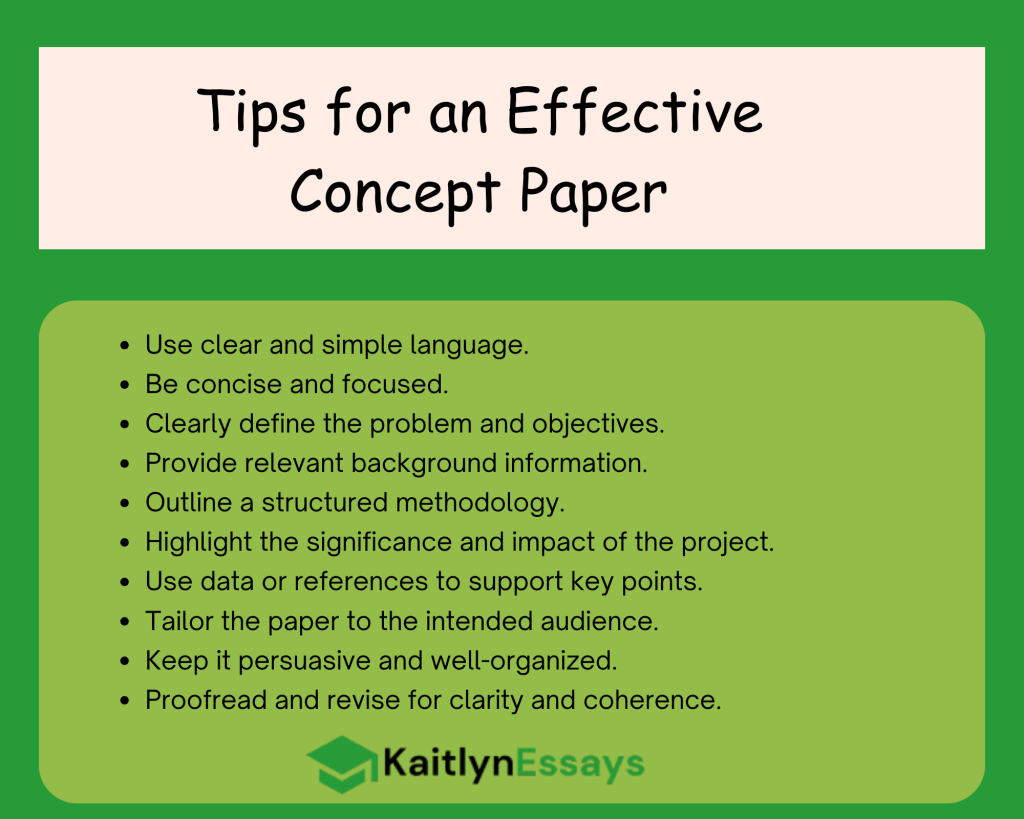
- Check for Clarity : Ensure the paper is easy to read and free of jargon. Use simple, direct language.
- Ensure Alignment : Verify that all sections align with the purpose and audience.
- Proofread : Eliminate grammatical errors, typos, and inconsistencies.
- Seek Feedback : Share the draft with colleagues, mentors, or stakeholders for input before finalizing.
Step 13: Format and Submit
- Follow Guidelines : Adhere to any formatting requirements specified by the audience (e.g., font size, margins, length).
- Use Visuals (Optional) : Include charts, graphs, or tables if they enhance understanding.
- Submit Professionally : Ensure the final document is polished and submitted according to the audience’s preferred method (e.g., email, online portal).
Example of a Concept Paper
Empowering Seniors in Elmwood with Essential Technology Skills
Introduction:
The rapid advancement of technology has transformed nearly every aspect of modern life, yet a significant portion of the senior citizen population remains digitally excluded. This exclusion limits their access to vital information, essential services, and social connections, contributing to social isolation and reduced quality of life. This project, “Bridging the Digital Divide,” aims to address this critical need by providing tailored digital literacy training and ongoing support to senior citizens in the Elmwood community, empowering them to confidently navigate the digital world.
Statement of Need/Problem Statement:
Elmwood is a community with a significant population of senior citizens (over 25% are aged 65+), many of whom face challenges in accessing and utilizing digital technologies. A recent survey conducted by the Elmwood Senior Center revealed that 65% of seniors reported feeling uncomfortable or intimidated by computers and the internet. They cited lack of training, fear of scams, and difficulty understanding complex interfaces as major barriers.
This digital divide prevents seniors from accessing online resources for healthcare information, connecting with family and friends through social media, managing their finances online, and participating in online community events. Without targeted interventions, this gap will continue to widen, further marginalizing seniors and limiting their opportunities for social engagement and well-being. The consequence is increased isolation, vulnerability to scams, and difficulty in accessing vital services increasingly offered online.
Project Description/Proposed Solution:
“Bridging the Digital Divide” proposes a comprehensive digital literacy program specifically designed for senior citizens in Elmwood. The program will consist of a series of hands-on workshops, one-on-one tutoring sessions, and ongoing technical support. The curriculum will be tailored to meet the specific needs and skill levels of participants, starting with basic computer skills (e.g., using a mouse and keyboard) and progressing to more advanced topics (e.g., email communication, online banking, safe internet browsing).
Workshops will be conducted in a comfortable and supportive environment at the Elmwood Senior Center, with assistive technology available for individuals with disabilities. The program will utilize a “train-the-trainer” model, empowering younger volunteers from the community to provide personalized assistance to seniors. We will partner with the Elmwood Public Library to provide access to computers and internet after training.
Goals and Objectives:
- Goal: To improve digital literacy and confidence among senior citizens in Elmwood.
- Objective 1: To train 50 senior citizens in basic computer skills, including using a mouse, keyboard, and internet browser, within the first six months of the project.
- Objective 2: To increase the number of seniors using online resources for health information by 25% within one year.
- Objective 3: To empower seniors to confidently use email and social media to connect with family and friends, with 80% of participants reporting increased social interaction within one year.
Project Activities/Methodology:
The project will be implemented in three phases:
- Needs Assessment and Curriculum Development (Month 1-2): Conduct a detailed needs assessment to identify the specific digital literacy needs of Elmwood seniors. Develop a customized curriculum based on the assessment findings.
- Training and Tutoring (Month 3-12): Conduct weekly workshops and one-on-one tutoring sessions at the Elmwood Senior Center. Provide ongoing technical support via phone and email.
- Evaluation and Sustainability (Month 12-14): Collect data on participant progress and program effectiveness. Develop a sustainability plan to ensure the program continues beyond the initial funding period.
Expected Outcomes/Impact:
This project is expected to have a significant positive impact on the lives of senior citizens in Elmwood. By improving their digital literacy skills, we anticipate:
- Increased access to vital information and services, including healthcare, government benefits, and online banking.
- Reduced social isolation and increased opportunities for connection with family and friends.
- Improved cognitive function and mental well-being.
- Greater confidence and independence in navigating the digital world.
- Increased participation in online community events and activities.
We expect at least 75% of participants to demonstrate proficiency in basic computer skills and report increased confidence in using technology. We anticipate a measurable increase in seniors using online resources for health information and connecting with family and friends online.
Evaluation Plan:
The project’s success will be evaluated through a combination of quantitative and qualitative methods:
- Pre- and post-tests: Assessing participants’ knowledge and skills before and after the training.
- Surveys: Gathering feedback from participants on their experiences and satisfaction with the program.
- Focus groups: Conducting discussions with participants to gather in-depth insights into the program’s impact.
- Tracking usage: Monitoring the number of seniors using computers and internet at the Elmwood Senior Center and Public Library.
Key indicators will include changes in test scores, survey responses, and usage patterns.
Budget Summary:
| Category | Estimated Cost |
| Personnel (Trainer, Coordinator) | $15,000 |
| Equipment (Laptops, Tablets) | $5,000 |
| Software & Licenses | $1,000 |
| Supplies (Training Materials) | $500 |
| Marketing & Outreach | $500 |
| Total | $22,000 |
This is an estimate and will be refined in a full budget proposal.
Team/Organization:
The Elmwood Senior Center, in partnership with the Elmwood Public Library and the Elmwood Community College Computer Science Department, will lead this project. The Elmwood Senior Center has a long history of serving the needs of seniors in the community and possesses a strong network of volunteers. The Elmwood Public Library provides access to computers and internet resources. The Elmwood Community College Computer Science Department will provide technical expertise and student volunteers to assist with training. The project will be overseen by [Name], Director of the Elmwood Senior Center, who has over 10 years of experience in developing and implementing programs for seniors.
Conclusion:
“Bridging the Digital Divide” represents a critical investment in the well-being and social inclusion of senior citizens in Elmwood. By providing targeted digital literacy training and ongoing support, this project will empower seniors to confidently navigate the digital world, access vital information and services, and connect with family and friends. We are confident that this project will have a significant positive impact on the lives of Elmwood seniors, and we seek your support to make it a reality. We believe with [Funder Name]’s support, we can make a lasting positive impact on the community.
Templates for a Concept Paper
Saint Augustine’s University – Covers sections like Introduction, Background & Purpose, Project Description, Evaluation, Budget, and Impact.
MSU Texas – Guides users in structuring their proposed research.
Millennium Challenge Corporation (MCC) – Provides guidance on structuring a project concept paper.
New York State Energy Research and Development Authority (NYSERDA) – Details content requirements for concept papers in the energy sector.
University of Connecticut (UConn) – Outlines five essential elements of a concept paper.
Appalachian Regional Commission (ARC) – Templates for organizations applying for ARISE funding.
FAQs
How to write a title for a concept paper?
Make it clear, specific, and engaging. Include your main research focus and goal. Keep it under 15 words if possible.
What are the headings of a concept paper?
Title, Introduction, Problem Statement, Purpose, Significance, Methodology, Resources Required, Timeline, Expected Outcomes, References.
What are the 10 examples of research titles in school?
Effects of Mindfulness on Student Stress Levels
Digital Learning Tools and Academic Performance
School Nutrition Programs and Childhood Obesity
Impact of Class Size on Elementary Reading Skills
Parent Involvement and Student Achievement
Effectiveness of Peer Tutoring Programs
Technology Integration in Science Classrooms
School Start Times and Adolescent Sleep Patterns
Environmental Education and Student Awareness
Cultural Diversity in Literature Curriculum