

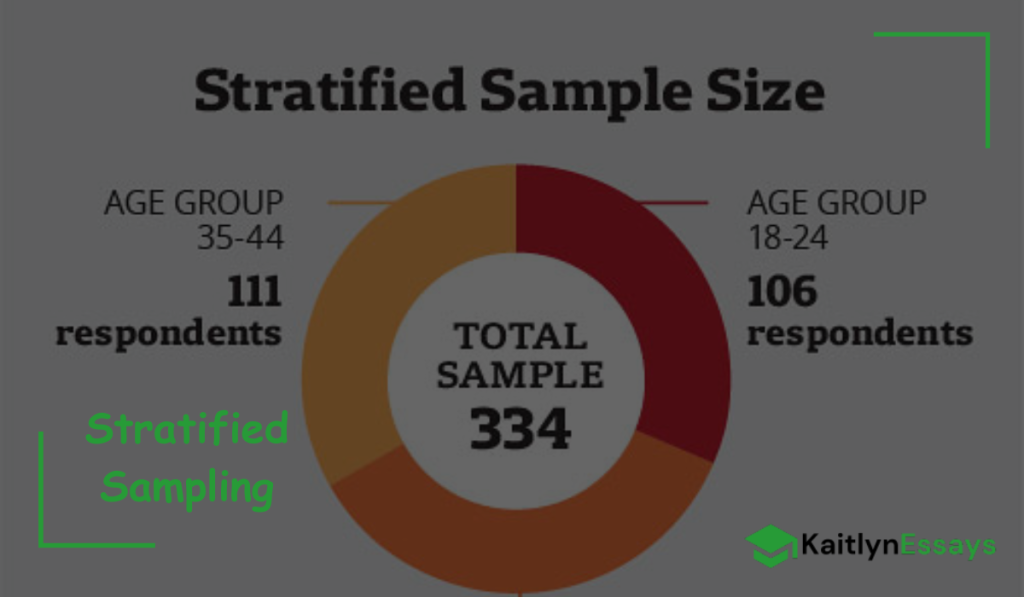
In research and statistics, collecting accurate data is essential for drawing meaningful conclusions. However, choosing the right group of people to represent a larger population can be challenging. This is where sampling methods come into play. One commonly used method is stratified sampling, which helps ensure that all important subgroups within a population are fairly represented. By dividing the population into smaller groups, or “strata,” based on shared characteristics such as age, income, or education level, researchers can select samples that reflect the diversity of the whole population.
What is Sampling?
In statistics, sampling is the process of selecting a group of individuals or items from a larger population to study. Since it’s often impossible or impractical to gather data from every single member of a population, researchers use samples to make predictions or conclusions about the whole group. A good sample should be representative, meaning it reflects the characteristics of the population as closely as possible.
For example, if a school wants to know students’ opinions about a new lunch menu, they might survey only 100 students instead of the entire student body. If those 100 students are chosen carefully, their responses can give a good idea of what the whole school thinks.
What is Stratified Sampling?
Stratified sampling is a specific type of probability sampling. In this method, the population is first divided into smaller groups, called strata (singular: stratum), based on a particular shared characteristic. These characteristics might include age, gender, income level, education, ethnicity, or geographic location. After dividing the population, researchers randomly select samples from each stratum.
The key idea is to make sure that each subgroup is represented in the sample, especially if certain groups are smaller or could be overlooked in a simple random sample.
Example:
Imagine a university has 10,000 students, and the administration wants to survey 1,000 students about campus facilities. The student population consists of:
- 60% undergraduates
- 30% graduate students
- 10% doctoral students
If the university uses stratified sampling, it would divide the students into three strata (undergraduate, graduate, doctoral) and then randomly select:
- 600 undergraduates
- 300 graduate students
- 100 doctoral students
This ensures that each group is properly represented according to its size in the population.
Types of Stratified Sampling
1. Proportionate Stratified Sampling
Explanation: In proportionate stratified sampling, the sample from each stratum maintains the same proportion as that stratum represents in the total population. This ensures the sample is a scaled-down version of the population.
Formula: Sample size from stratum = (Stratum size / Population size) × Total sample size
Example: A university wants to survey 500 students about campus facilities. The student body consists of:
- Freshmen: 4,000 students (40%)
- Sophomores: 3,000 students (30%)
- Juniors: 2,000 students (20%)
- Seniors: 1,000 students (10%)
- Total: 10,000 students
Using proportionate stratified sampling:
- Freshmen sample: (4,000/10,000) × 500 = 200 students
- Sophomores sample: (3,000/10,000) × 500 = 150 students
- Juniors sample: (2,000/10,000) × 500 = 100 students
- Seniors sample: (1,000/10,000) × 500 = 50 students
This maintains the same 40:30:20:10 ratio as the population.
2. Disproportionate Stratified Sampling
Explanation: Sample sizes from each stratum are deliberately different from their population proportions. This is useful when certain groups are particularly important to study or when some strata are too small for meaningful analysis.
Example: A medical researcher studying a rare genetic condition wants to survey 1,000 people. The population consists of:
- Healthy individuals: 95% of population
- Individuals with the rare condition: 5% of population
Using proportionate sampling would give only 50 people with the condition, which is insufficient for analysis. Instead, the researcher uses disproportionate sampling:
- Healthy individuals: 500 people (50% of sample)
- Individuals with rare condition: 500 people (50% of sample)
This oversamples the rare condition group to ensure adequate data for comparison and analysis.
3. Optimal Allocation Stratified Sampling
Explanation: This method determines sample sizes based on three factors: stratum size, variability within each stratum, and sampling costs. The goal is to achieve maximum precision for a given cost or minimum cost for a given precision level.
Formula considerations:
- Larger samples from strata with higher variability
- Larger samples from strata with lower sampling costs
- Considers stratum size in the population
Example: A market research company studying household income across three neighborhoods:
Neighborhood A (Affluent):
- Population: 1,000 households
- Income variability: Low (σ = $10,000)
- Sampling cost: High ($50 per survey)
Neighborhood B (Middle-class):
- Population: 2,000 households
- Income variability: Medium (σ = $20,000)
- Sampling cost: Medium ($30 per survey)
Neighborhood C (Mixed-income):
- Population: 1,500 households
- Income variability: High (σ = $40,000)
- Sampling cost: Low ($20 per survey)
Using optimal allocation, Neighborhood C would receive the largest sample size despite being middle-sized, because it has the highest variability and lowest cost. The exact allocation would be calculated using statistical formulas considering all three factors.
4. Equal Allocation Stratified Sampling
Explanation: Each stratum receives exactly the same sample size, regardless of its proportion in the population. This method is ideal when the primary goal is comparing different groups rather than making population estimates.
Example: A pharmaceutical company testing a new drug’s effectiveness across different age groups wants to ensure sufficient data for each group comparison:
Population breakdown:
- Ages 18-30: 60% of eligible patients
- Ages 31-50: 30% of eligible patients
- Ages 51-70: 10% of eligible patients
Using equal allocation for a total sample of 300:
- Ages 18-30: 100 patients
- Ages 31-50: 100 patients
- Ages 51-70: 100 patients
This ensures each age group has sufficient representation for statistical analysis and comparison, even though the 51-70 group is heavily oversampled relative to its population proportion.
Steps in Conducting Stratified Sampling
Step 1: Define the Target Population
Explanation: Clearly identify and define the population you want to study. This includes specifying the boundaries, characteristics, and scope of your population.
Example: A researcher studying job satisfaction wants to survey employees at a large corporation. The target population is defined as:
- All full-time employees
- Currently employed for at least 6 months
- Working at the company’s headquarters
- Total population: 5,000 employees
Step 2: Identify Stratification Variables
Explanation: Choose the characteristics or variables that will be used to divide the population into strata. These should be relevant to your research question and create meaningful subgroups.
Key considerations:
- Variables should be related to the study outcome
- Should create homogeneous groups within strata
- Should create heterogeneous groups between strata
- Must be measurable and available for all population members
Example: For the job satisfaction study, the researcher chooses two stratification variables:
- Department: Marketing, Sales, IT, Human Resources, Finance
- Experience level: Less than 2 years, 2-5 years, More than 5 years
This creates meaningful groups that likely have different job satisfaction levels.
Step 3: Create Strata (Subgroups)
Explanation: Divide the population into mutually exclusive and collectively exhaustive strata based on the chosen variables. Each population member should belong to exactly one stratum.
Example: Using the two variables above, the researcher creates 15 strata:
| Department | Experience Level | Population Size |
|---|---|---|
| Marketing | <2 years | 200 |
| Marketing | 2-5 years | 300 |
| Marketing | >5 years | 250 |
| Sales | <2 years | 400 |
| Sales | 2-5 years | 350 |
| Sales | >5 years | 300 |
| IT | <2 years | 300 |
| IT | 2-5 years | 400 |
| IT | >5 years | 200 |
| HR | <2 years | 150 |
| HR | 2-5 years | 200 |
| HR | >5 years | 100 |
| Finance | <2 years | 250 |
| Finance | 2-5 years | 300 |
| Finance | >5 years | 200 |
Step 4: Determine Total Sample Size
Explanation: Calculate the overall sample size needed for your study using appropriate statistical methods, considering factors like desired precision, confidence level, and expected effect size.
Example: Using sample size calculation formulas or software, the researcher determines that 400 employees need to be surveyed to achieve 95% confidence level with a 5% margin of error.
Step 5: Choose Stratified Sampling Method
Explanation: Select the appropriate type of stratified sampling based on your research objectives and constraints.
Example: The researcher chooses proportionate stratified sampling because the goal is to make generalizations about overall job satisfaction across the entire company while ensuring all departments and experience levels are represented.
Step 6: Calculate Sample Size for Each Stratum
Explanation: Determine how many participants to select from each stratum based on the chosen stratified sampling method.
Example using proportionate allocation:
| Stratum | Population | Proportion | Sample Size |
|---|---|---|---|
| Marketing <2 years | 200 | 200/5000 = 0.04 | 0.04 × 400 = 16 |
| Marketing 2-5 years | 300 | 300/5000 = 0.06 | 0.06 × 400 = 24 |
| Marketing >5 years | 250 | 250/5000 = 0.05 | 0.05 × 400 = 20 |
| Sales <2 years | 400 | 400/5000 = 0.08 | 0.08 × 400 = 32 |
| … (continue for all strata) | … | … | … |
Step 7: Obtain Sampling Frame for Each Stratum
Explanation: Create a complete list of all population members within each stratum. This serves as the basis for random selection within each stratum.
Example: The researcher obtains employee lists from HR, organized by:
- Department databases with employee IDs
- Experience level calculated from hire dates
- Contact information for selected employees
Sampling frames might include:
- Employee ID numbers
- Names and contact information
- Department codes
- Hire dates
Step 8: Select Sample from Each Stratum
Explanation: Use simple random sampling or systematic sampling to select the required number of participants from each stratum.
Methods for selection:
- Simple random sampling: Use random number generators or lottery method
- Systematic sampling: Select every kth person from the list
- Technology tools: Statistical software, online random selectors
Example: For the Marketing <2 years stratum (200 employees, need 16):
- Number each employee from 1 to 200
- Use random number generator to select 16 numbers
- Contact employees corresponding to selected numbers
Step 9: Collect Data from Selected Participants
Explanation: Implement your data collection method (surveys, interviews, observations) with the selected participants from each stratum.
Best practices:
- Track response rates by stratum
- Follow up with non-respondents
- Document any sampling or response biases
- Maintain stratum identification for analysis
Example: The researcher sends online surveys to all 400 selected employees, tracking responses by department and experience level to ensure adequate representation from each stratum.
Step 10: Analyze Data Considering Stratification
Explanation: Analyze your data taking into account the stratified sampling design. This may require special statistical techniques or weighting procedures.
Analysis considerations:
- For proportionate sampling: Standard analysis methods often apply
- For disproportionate sampling: May need to weight results back to population proportions
- Subgroup analysis: Compare results across strata
- Overall estimates: Combine stratum results appropriately
Example: The researcher analyzes job satisfaction by:
- Calculating means and confidence intervals for each stratum
- Computing overall company job satisfaction (weighted if necessary)
- Comparing satisfaction levels across departments and experience levels
- Testing for significant differences between strata
Common Challenges and Solutions
Challenge 1: Overlapping strata
- Solution: Clearly define mutually exclusive categories
Challenge 2: Unequal stratum sizes
- Solution: Consider disproportionate allocation for very small strata
Challenge 3: Missing stratification information
- Solution: Use alternative data sources or proxy variables
Challenge 4: Non-response varies by stratum
- Solution: Implement stratum-specific follow-up strategies
Challenge 5: Cost variations across strata
- Solution: Consider optimal allocation to balance cost and precision
Advantages of Stratified Sampling
1. Increased Precision and Accuracy
Explanation: Stratified sampling reduces sampling error by ensuring that each important subgroup is adequately represented. This leads to more precise estimates compared to simple random sampling.
How it works:
- Reduces within-sample variability
- Eliminates the chance of over-representing or under-representing important subgroups
- Provides more accurate population estimates
Example: A political polling organization studying voter preferences stratifies by age groups (18-30, 31-50, 51+). Without stratification, they might randomly select mostly older voters, skewing results. Stratification ensures each age group is properly represented, leading to more accurate predictions of overall voting patterns.
Statistical benefit: The standard error of estimates is typically smaller in stratified sampling than in simple random sampling when the stratification variable is correlated with the study variable.
2. Guaranteed Representation of All Subgroups
Explanation: Stratified sampling ensures that every important subgroup in the population is represented in the sample, preventing the complete exclusion of minority or smaller groups.
Example: A university studying student satisfaction stratifies by academic year:
- Without stratification: Might randomly select mostly freshmen and sophomores
- With stratification: Guarantees representation from freshmen, sophomores, juniors, and seniors
This is particularly valuable when studying diverse populations where certain groups might be underrepresented in a purely random sample.
3. Enables Subgroup Analysis
Explanation: Researchers can conduct detailed analysis within each stratum and make comparisons between different subgroups with statistical confidence.
Benefits:
- Allows for separate estimates for each subgroup
- Enables comparison between strata
- Supports hypothesis testing between groups
- Provides insights into group-specific patterns
Example: A healthcare study on treatment effectiveness stratifies patients by:
- Age groups: Young adults, middle-aged, elderly
- Gender: Male, female
- Disease severity: Mild, moderate, severe
This allows researchers to analyze treatment effectiveness for each specific group and identify which demographics respond best to the treatment.
4. Administrative Convenience and Cost Efficiency
Explanation: When the population is naturally organized into strata, stratified sampling can be more convenient and cost-effective than other sampling methods.
Practical advantages:
- Utilizes existing organizational structures
- Reduces travel and coordination costs
- Simplifies data collection logistics
- Leverages available sampling frames
Example: A company studying employee satisfaction across multiple office locations:
- Stratified approach: Sample employees within each office location
- Benefits: Researchers can visit each office once, coordinate with local managers, and use existing employee directories
- Cost savings: Reduces travel time and administrative overhead compared to randomly selecting employees across all locations
5. Flexibility in Sampling Design
Explanation: Stratified sampling allows researchers to customize their approach based on the importance, variability, or cost considerations of different subgroups.
Types of flexibility:
- Proportionate allocation: Maintain population proportions
- Disproportionate allocation: Oversample important or rare groups
- Optimal allocation: Balance precision and cost
- Equal allocation: Ensure equal representation for comparisons
Example: A market research study on smartphone preferences:
- High-income stratum: Smaller sample (low variability in preferences)
- Middle-income stratum: Proportionate sample
- Low-income stratum: Larger sample (high variability, key target market)
This flexibility allows optimal resource allocation based on research priorities.
6. Reduced Sampling Bias
Explanation: Stratification minimizes the risk of sampling bias by preventing the accidental over-representation or under-representation of certain groups that might occur with simple random sampling.
How it prevents bias:
- Eliminates chance fluctuations in group representation
- Ensures balanced sample composition
- Reduces systematic errors in population estimates
Example: A study on educational achievement stratifies by socioeconomic status:
- Without stratification: Might randomly select mostly middle-class students
- With stratification: Ensures representation from low, middle, and high socioeconomic backgrounds
- Result: More accurate picture of overall educational achievement patterns
7. Improved Statistical Power
Explanation: Stratified sampling often provides greater statistical power for detecting differences and relationships, especially when comparing subgroups.
Benefits:
- More efficient use of sample size
- Better ability to detect significant differences
- Reduced Type II error (failing to detect true effects)
- More reliable statistical inferences
Example: A clinical trial testing a new medication stratifies by disease severity:
- Each severity level has adequate sample size
- Can detect treatment effects within each stratum
- Has power to identify if treatment works better for certain severity levels
- Overall treatment effect estimate is more precise
8. Quality Control and Monitoring
Explanation: Stratification allows researchers to monitor data collection quality and response rates within each subgroup, enabling targeted improvements.
Monitoring capabilities:
- Track response rates by stratum
- Identify problems in specific subgroups
- Implement stratum-specific follow-up strategies
- Ensure data quality across all groups
Example: An online survey about digital literacy stratifies by age groups:
- Monitoring reveals: Low response rate among elderly participants
- Action taken: Implement phone interviews for this stratum
- Result: Maintain adequate representation across all age groups
9. Enhanced Generalizability
Explanation: Because stratified sampling ensures representation from all important subgroups, findings are more generalizable to the entire population.
Generalizability benefits:
- Results apply to the full population diversity
- Findings are robust across different subgroups
- Reduces external validity concerns
- Supports broader application of results
Example: A study on job training effectiveness stratifies by education level, industry, and geographic region. The comprehensive representation means findings can be confidently applied to the broader workforce population.
10. Better Resource Allocation
Explanation: Researchers can allocate their time, budget, and effort more efficiently by customizing data collection strategies for each stratum.
Resource optimization:
- Different data collection methods for different strata
- Varied follow-up strategies
- Customized incentives
- Efficient use of research team skills
Example: A community health study stratifies by neighborhood:
- Affluent areas: Online surveys (cost-effective)
- Working-class areas: Phone interviews (better response)
- Low-income areas: Door-to-door interviews with incentives
- Result: Optimal response rates within budget constraints
Disadvantages of Stratified Sampling
1. Increased Complexity in Design and Implementation
Explanation: Stratified sampling requires more planning, coordination, and technical expertise compared to simple random sampling, making the entire research process more complex.
Areas of complexity:
- Determining appropriate stratification variables
- Creating mutually exclusive strata
- Calculating sample sizes for each stratum
- Managing multiple sampling frames
- Coordinating data collection across strata
Example: A national health survey stratifying by state, age group, income level, and urban/rural status creates 200+ strata. The research team must:
- Manage 200+ separate sampling frames
- Calculate individual sample sizes for each stratum
- Coordinate data collection across multiple locations
- Train fieldworkers for different demographic groups
- Track progress separately for each stratum
This complexity increases the likelihood of errors and requires specialized expertise that may not be available in all research settings.
2. Higher Costs and Resource Requirements
Explanation: The additional planning, administration, and coordination required for stratified sampling typically results in higher costs compared to simpler sampling methods.
Cost factors:
- Extended planning and design phase
- Multiple sampling frames development
- Specialized training for research staff
- Complex data collection logistics
- Advanced statistical analysis requirements
- Quality control across multiple strata
Example: A market research company conducting a product preference study:
Simple Random Sampling Costs:
- Sampling frame: $5,000
- Training: $2,000
- Data collection: $15,000
- Analysis: $3,000
- Total: $25,000
Stratified Sampling Costs:
- Multiple sampling frames: $12,000
- Extended planning: $8,000
- Specialized training: $5,000
- Complex data collection: $25,000
- Advanced analysis: $7,000
- Total: $57,000
The stratified approach costs more than double due to increased complexity.
3. Requirement for Prior Knowledge About Population
Explanation: Effective stratification requires detailed advance knowledge about the population characteristics, which may not always be available or accurate.
Information needed:
- Distribution of stratification variables in the population
- Correlation between stratification variables and study outcomes
- Size of each potential stratum
- Variability within each stratum
- Accessibility of different subgroups
Example: A researcher studying social media usage wants to stratify by income levels but discovers:
- No recent income distribution data available for the target population
- Income categories used in available data don’t match research needs
- Significant changes in income distribution due to recent economic events
- Privacy concerns prevent access to detailed demographic information
Consequences:
- Poor stratification choices reduce sampling efficiency
- Inaccurate population information leads to inappropriate sample allocation
- May result in worse performance than simple random sampling
4. Risk of Over-Stratification
Explanation: Creating too many strata or using inappropriate stratification variables can actually reduce sampling efficiency and increase complexity without providing benefits.
Problems with over-stratification:
- Very small strata with inadequate sample sizes
- Increased administrative burden
- Reduced statistical power within strata
- Higher costs without proportional benefits
- Complicated analysis and interpretation
Example: A student satisfaction survey at a small college (2,000 students) stratifies by:
- Academic year (4 strata)
- Major field (15 strata)
- Residence type (3 strata)
- Part-time vs. full-time (2 strata)
This creates 4 × 15 × 3 × 2 = 360 potential strata. With a sample size of 400 students, most strata would have 0-2 students, making meaningful analysis impossible within most strata.
Better approach: Use fewer, more meaningful stratification variables like academic year and major field only.
5. Potential for Sampling Frame Errors
Explanation: Stratified sampling requires accurate and complete sampling frames for each stratum, and errors in these frames can significantly impact sample quality.
Types of frame errors:
- Coverage errors: Missing population members from frames
- Duplication: Same individuals appearing in multiple frames
- Ineligible units: Including non-target population members
- Outdated information: Changes in stratification characteristics over time
Example: A workplace safety study stratifies employees by department using company databases:
Problems discovered:
- IT department list includes contractors (not target population)
- Recent reorganization moved employees between departments
- Part-time employees missing from some departmental lists
- Employees on leave still listed as active
- New hires not yet added to departmental databases
Impact: Sample may not accurately represent the intended strata, leading to biased results.
6. Difficulty in Determining Optimal Stratum Boundaries
Explanation: Deciding where to draw boundaries between strata can be challenging and arbitrary, potentially affecting the effectiveness of stratification.
Boundary challenges:
- Continuous variables require artificial cut-points
- Different boundary choices can lead to different results
- Optimal boundaries may not be intuitive or practical
- Boundaries may not remain optimal over time
Example: A study on consumer spending habits stratifies by income:
Option 1: Low (<$30,000), Middle ($30,000-$70,000), High (>$70,000) Option 2: Low (<$25,000), Lower-middle ($25,000-$50,000), Upper-middle ($50,000-$80,000), High (>$80,000) Option 3: Based on quartiles of actual income distribution
Each choice creates different strata compositions and may yield different results. The researcher must justify their choice, but the “correct” boundaries are often unclear.
7. Challenges in Data Analysis and Interpretation
Explanation: Analyzing stratified samples requires specialized statistical techniques and can complicate interpretation, especially when different allocation methods are used.
Analytical challenges:
- Weighting requirements: Disproportionate sampling requires complex weighting
- Multiple comparisons: Testing differences between many strata increases Type I error risk
- Unequal sample sizes: Complicates statistical tests and interpretation
- Specialized software: May require advanced statistical packages
Example: A health study uses disproportionate stratified sampling, oversampling rare disease patients:
Analysis complications:
- Results must be weighted back to population proportions for overall estimates
- Confidence intervals require complex calculations
- Standard statistical software may not handle weights properly
- Interpreting weighted vs. unweighted results can be confusing
- Reporting becomes more complex for stakeholders
8. Limited Flexibility During Data Collection
Explanation: Once strata are defined and sample sizes allocated, researchers have limited ability to adjust the sampling strategy if problems arise during data collection.
Flexibility limitations:
- Cannot easily reallocate sample sizes between strata
- Difficult to add new strata if needed
- Challenging to modify stratification variables mid-study
- Response rate problems in specific strata are hard to address
Example: A community survey stratified by neighborhood encounters problems:
- One neighborhood has much lower response rates than expected
- A new housing development creates a new demographic group
- Economic changes alter the income distribution used for stratification
- Some neighborhoods become inaccessible due to construction
Consequences: Researchers may end up with unbalanced samples or need to restart portions of the study.
9. Risk of Stratification Variable Becoming Outdated
Explanation: Population characteristics used for stratification may change over time, making the stratification scheme less effective or even inappropriate.
Types of changes:
- Demographic shifts in the population
- Changes in organizational structures
- Economic or social changes affecting strata
- Policy changes affecting group definitions
Example: A longitudinal study of job satisfaction stratified by company departments:
Changes over 3 years:
- Company merger eliminates some departments
- New technology creates entirely new departments
- Remote work policies blur departmental boundaries
- Reorganization changes reporting structures
The original stratification becomes less meaningful, but changing it mid-study creates methodological problems.
10. Increased Training Requirements for Research Staff
Explanation: Stratified sampling requires research teams to understand more complex procedures, increasing training time and the potential for implementation errors.
Training needs:
- Understanding different sampling methods within strata
- Managing multiple sampling frames
- Calculating and applying sampling weights
- Conducting stratum-specific quality control
- Using specialized analysis software
Example: A multi-site clinical trial with stratified sampling requires:
- Site coordinators trained on stratum-specific protocols
- Data collectors understanding different procedures for each stratum
- Analysts trained on complex weighting procedures
- Quality control staff monitoring multiple sampling frames
- Project managers coordinating across diverse strata
Risks: Inadequate training can lead to implementation errors that compromise the entire study.
Real-World Examples and Applications
1. Political Polling and Election Forecasting
Application: Political polling organizations use stratified sampling to predict election outcomes and gauge public opinion on various issues.
Stratification Variables:
- Geographic regions (states, counties, urban/rural)
- Age groups (18-29, 30-49, 50-64, 65+)
- Gender (male, female)
- Education level (high school, college, graduate)
- Political affiliation (Democrat, Republican, Independent)
- Income brackets
Real Example: 2020 U.S. Presidential Election Polling The Pew Research Center conducted pre-election polls using stratified sampling:
- Geographic stratification: 50 states plus D.C.
- Demographic stratification: Age, race, education, gender
- Sample allocation: Proportionate to likely voter turnout in each stratum
- Sample size: 10,000+ registered voters
- Method: Phone and online surveys with stratum-specific quotas
Results and Impact:
- Provided accurate predictions within margin of error
- Identified key demographic trends and voting patterns
- Enabled analysis of subgroup preferences (e.g., suburban women, young voters)
- Informed campaign strategies and media coverage
Why Stratified Sampling was Essential: Simple random sampling might miss key demographic groups or over-represent certain regions, leading to inaccurate predictions.
2. National Health Surveys
Application: Government health agencies use stratified sampling to monitor population health trends and inform public policy.
Real Example: National Health and Nutrition Examination Survey (NHANES) The CDC conducts NHANES every two years to assess health and nutritional status of Americans.
Stratification Design:
- Geographic: 15 locations across the U.S.
- Age groups: 0-5, 6-11, 12-19, 20-39, 40-59, 60+
- Race/ethnicity: Non-Hispanic White, Non-Hispanic Black, Hispanic, Asian, Other
- Income level: Below/above poverty line
Sample Allocation:
- Total sample: ~5,000 people per cycle
- Oversampling: Minorities, elderly, and low-income groups
- Method: Disproportionate allocation to ensure adequate representation
Data Collection:
- Physical examinations at mobile examination centers
- Laboratory tests and health interviews
- Dietary assessments and lifestyle questionnaires
Impact:
- Tracks obesity trends (identified the obesity epidemic)
- Monitors chronic disease prevalence
- Evaluates nutrition programs effectiveness
- Guides dietary recommendations and health policies
- Identifies health disparities among different groups
3. Market Research and Consumer Studies
Application: Companies use stratified sampling to understand consumer preferences, test products, and develop marketing strategies.
Real Example: Smartphone Market Research A major technology company researching smartphone preferences across different market segments.
Stratification Variables:
- Age groups: Gen Z (18-24), Millennials (25-40), Gen X (41-56), Boomers (57+)
- Income levels: <$35k, $35k-$75k, $75k-$150k, >$150k
- Geographic regions: Urban, suburban, rural
- Current phone type: iPhone, Android, Other
Sample Design:
- Total sample: 2,400 consumers
- Allocation: Proportionate by income and age, oversampling high-income users
- Method: Online surveys with mobile app testing
Key Findings:
- Identified feature preferences by age group
- Discovered pricing sensitivity across income levels
- Revealed geographic differences in brand loyalty
- Informed product development and marketing strategies
Business Impact:
- Guided $50M product development investment
- Targeted advertising campaigns by demographic
- Pricing strategy optimization
- Feature prioritization for next product release
4. Educational Assessment and Research
Application: Educational organizations use stratified sampling to evaluate student performance, test effectiveness of interventions, and conduct large-scale assessments.
Real Example: Programme for International Student Assessment (PISA) OECD’s PISA assesses 15-year-old students’ performance in reading, mathematics, and science across participating countries.
Stratification Design:
- School type: Public, private, vocational
- Geographic regions: Urban, rural, by administrative regions
- School size: Small, medium, large
- Socioeconomic status: Based on school demographics
Sample Implementation:
- Two-stage sampling: First schools, then students within schools
- Target sample: 5,000-7,000 students per country
- Allocation: Ensures representation across all strata
- Quality control: Strict participation rates required
Global Impact:
- Influences education policy in 80+ countries
- Identifies best practices in high-performing systems
- Reveals equity issues in educational outcomes
- Guides billions in education funding decisions
Specific Example – Finland’s Success: PISA results showed Finland’s education system achieving high performance with low inequality, leading other countries to study and adopt Finnish approaches.
5. Clinical Trials and Medical Research
Application: Medical researchers use stratified sampling to ensure diverse participation in clinical trials and improve generalizability of results.
Real Example: COVID-19 Vaccine Trials Pfizer-BioNTech COVID-19 vaccine Phase 3 trial used stratified sampling to ensure diverse representation.
Stratification Variables:
- Age groups: 16-55, 56-75, 76+
- Comorbidity status: High risk, standard risk
- Geographic location: Multiple countries and regions
- Healthcare worker status: Healthcare workers vs. general population
- Race/ethnicity: Multiple categories to ensure diversity
Sample Design:
- Total enrollment: 43,548 participants
- Allocation: Ensured adequate representation of high-risk groups
- Primary endpoint: Efficacy across all strata
- Safety monitoring: Continuous across all demographic groups
Critical Outcomes:
- Demonstrated 95% efficacy across age groups
- Confirmed safety profile in diverse populations
- Enabled regulatory approval based on representative data
- Informed vaccination priority guidelines
Regulatory Impact: FDA approval was granted partly because the diverse, stratified sample provided evidence of effectiveness across different demographic groups.
6. Economic and Labor Market Surveys
Application: Government statistical agencies use stratified sampling to monitor employment, wages, and economic conditions.
Real Example: Current Population Survey (CPS) The U.S. Census Bureau and Bureau of Labor Statistics conduct monthly CPS to track employment statistics.
Stratification Design:
- Geographic: States divided into Primary Sampling Units (PSUs)
- Metropolitan status: Metro vs. non-metro areas
- Housing unit characteristics: Owner vs. renter occupied
- Demographic composition: Race, age, education distributions
Sample Implementation:
- Sample size: ~60,000 households monthly
- Rotation: Households surveyed for 4 months, off 8 months, then 4 more months
- Weighting: Complex weights to represent national population
- Data collection: Computer-assisted telephone interviews
Economic Impact:
- Produces official unemployment rate reported monthly
- Tracks labor force participation trends
- Monitors wage growth across demographics
- Informs Federal Reserve monetary policy decisions
- Guides workforce development programs
Policy Influence: Monthly unemployment figures influence trillion-dollar fiscal and monetary policy decisions.
7. Environmental and Climate Research
Application: Environmental scientists use stratified sampling to monitor ecological conditions and climate change impacts.
Real Example: Forest Inventory and Analysis (FIA) The U.S. Forest Service conducts ongoing forest monitoring using stratified sampling.
Stratification Variables:
- Forest type: Hardwood, softwood, mixed
- Ownership: Public, private industrial, private non-industrial
- Geographic region: Ecological provinces and sections
- Forest density: Dense, moderate, sparse canopy cover
Sample Design:
- Plot network: ~125,000 permanent plots across U.S.
- Sampling intensity: One plot per ~6,000 acres
- Measurement cycle: 5-10 years depending on region
- Data collected: Tree species, size, health, growth rates
Environmental Impact:
- Tracks forest health and carbon sequestration
- Monitors biodiversity and species composition changes
- Assesses wildfire risks and impacts
- Evaluates climate change effects on forests
- Informs sustainable forestry practices
Policy Applications:
- Carbon credit programs use FIA data
- Endangered species habitat assessments
- Climate change adaptation strategies
- Forest management guidelines
8. Social Services and Welfare Research
Application: Government agencies use stratified sampling to evaluate social programs and understand service needs.
Real Example: Survey of Income and Program Participation (SIPP) U.S. Census Bureau tracks participation in government assistance programs.
Stratification Approach:
- Geographic regions: States and metropolitan areas
- Income levels: Multiple poverty-related thresholds
- Household composition: Single adults, families with children, elderly
- Program participation: Current recipients vs. eligible non-recipients
Research Focus:
- Sample size: ~40,000 households
- Duration: Multi-year longitudinal study
- Topics: Food stamps, Medicaid, housing assistance, unemployment benefits
Policy Impact:
- Evaluates program effectiveness and fraud
- Identifies barriers to program participation
- Informs benefit level adjustments
- Guides program design improvements
- Estimates program costs and participation rates
9. Transportation and Urban Planning
Application: Transportation agencies use stratified sampling to understand travel patterns and plan infrastructure.
Real Example: National Household Travel Survey (NHTS) U.S. Department of Transportation surveys household travel behavior.
Stratification Design:
- Geographic: Metropolitan areas, rural regions
- Household size: 1 person, 2-3 persons, 4+ persons
- Income brackets: Multiple categories
- Vehicle ownership: 0, 1, 2, 3+ vehicles
- Housing density: Urban core, suburban, rural
Data Collection:
- Sample size: ~150,000 households
- Travel diary: 7-day detailed trip records
- Methods: Phone interviews, online surveys, GPS tracking
Planning Applications:
- Highway capacity planning and funding allocation
- Public transit route optimization
- Traffic congestion management strategies
- Environmental impact assessments
- Active transportation (walking, cycling) infrastructure
10. Quality Control in Manufacturing
Application: Manufacturing companies use stratified sampling for quality control and process improvement.
Real Example: Automotive Parts Quality Testing A major automotive manufacturer implementing stratified sampling for parts inspection.
Stratification Variables:
- Production shift: Day, evening, night shifts
- Machine/production line: Different equipment units
- Material batch: Different raw material lots
- Time period: Weekly production cycles
- Part complexity: Simple, moderate, complex parts
Quality Control Implementation:
- Inspection sample: 2% of daily production
- Allocation: Proportionate across shifts and lines
- Testing protocol: Dimensional accuracy, durability, finish quality
- Response system: Immediate feedback to production teams
Business Results:
- Reduced defect rates by 40%
- Identified specific machines needing maintenance
- Improved supplier material consistency
- Decreased customer complaints and warranty costs
- Enhanced overall product reliability
FAQs
What is the difference between random sampling and stratified sampling?
Random sampling selects individuals randomly from the entire population, while stratified sampling divides the population into strata (subgroups) based on a characteristic and samples from each stratum to ensure representation.
What is the difference between stratified and cluster sampling?
Stratified sampling samples from every stratum (subgroup) of the population, while cluster sampling divides the population into clusters (e.g., geographic areas) and randomly selects entire clusters to sample.
What is snowball sampling with an example?
A non-probability method where participants recruit others, growing the sample like a snowball. Example: Studying a rare disease by asking diagnosed patients to refer others with the same condition.